Thursday, February 12, 2015

Golden Tips, Gopaldhara Gold Darjeeling Black Tea

Golden Tips Description:
Among the most sought after invoice's from the years pre-winter harvest, the Gopaldhara Gold is an autumnal beauty. A delicate yet rounded black tea with intricate flowery notes. The tea brings about a subtle and sweet profile with hints of fine muscatel and an slightly earthy roundness. The lingering aftertaste brings in sensations of dark bold chocolate and cocoa. A fantastic leaf tea texture with golden tips spread evenly, this is definitely among our better autumn Darjeeling's.

Sample provided by Golden Tips

My Review:
Today I continue my education with an autumn flush Darjeeling. I usually try to start these reviews with a photograph of the sample packaging. It helps me to see the thought and care that goes into a shipment. Golden Tips does an excellent job. All the samples have been completely sealed and carefully labeled.

Opening the pouch I get an interesting assortment of aromas. It first says tobacco to me, then no, its cocoa. Wait, I'm getting something very sweet. My brain can't focus it. Thoughts of mint, orange, citrus, and candy flash past me.

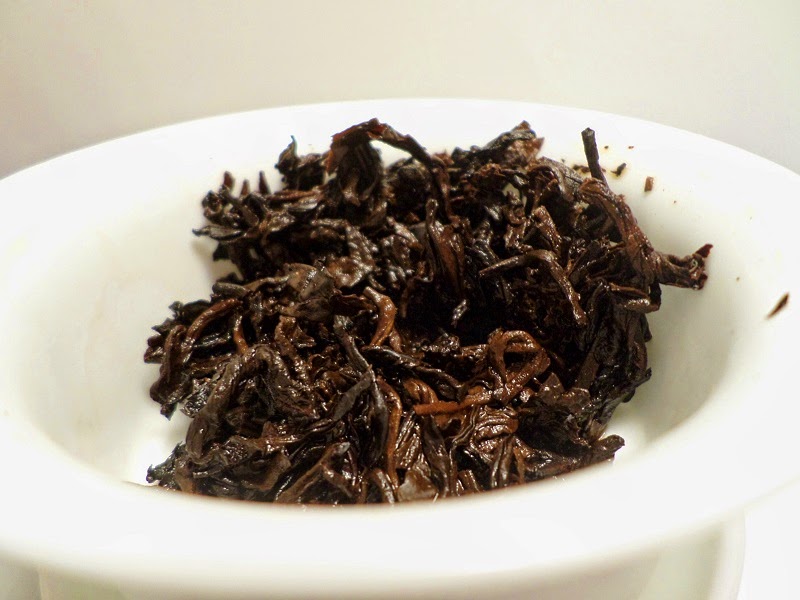
Removing a spoon of leaf had me feeling warm and fuzzy on this very cold February day. The leaf looks so much like fall. There is a touch of green left, while being mainly various shades of tans and browns. I do see a stem or two in the mix.

Looking over my growing collection of brewing equipment, I chose the Bodum press. I don't have a reason other than it has served me well and clean up is pretty straight forward.

The water was heated to 200F. I couldn't decide between boiling and 195F, so this is my compromise. The steep was 3 1/2 minutes. The recommended is 3-5.

The brew is orange brown and light in the depth of the tint. By that I mean it is opaque rather than a solid impenetrable color. It seems quite clear with no floaters or cloudiness. It is kind of shiny.

The aroma of the wet leaves is pretty noteworthy. It is dominated by a wonderful grapiness. I know Darjeeling is noted for its Muscatel grape aroma but this one is so nice. Along with the grape is a woodsy scent and a hint of chocolate. Yeah, I know.

The sip is clean with no bitterness. Its rather mellow at 3 1/2 minutes. There is only a mild briskness. I think this would take hotter and longer in stride.

This may be the very first Darjeeling I have ever tried where I understand why some people are obsessed with them. Most of the time I can't tell a lot of difference between Darjeeling and Nepalese. This one stands out to  me.

After a little jolt of briskness, I get grape, but it isn't straight up grape. It has a fuller taste like a hit of citrus is backing it up. This is followed by an awareness of the woodsy leaf taste with just a hint of chocolate. As that fades the grape rises up again and remains in the lingering aftertaste.

There is just a touch of dryness but who cares. This is really a pretty amazingly tasty tea.

You can find Golden Tips, Gopaldhara Gold Darjeeling Black Tea here.

Tuesday, February 10, 2015

Jalam Teas, Manmai

Jalam Teas Description:
Manmai fermented (green) Puerh is a return to one of our most coveted regions, Bada Mountain, and a true ‘high mountain tea’. Manmai village is located in the Bada Mountain range and has fantastic conditions for producing superb teas. High humidity levels, mists that filter sun and rain and an almost wild aspect to the geography make this a “zone of perfect tea possibilities”

Sample provided by Jalam Teas

My Review:
Jalam Teas contacted me to see if I would like to review one of their puerh teas for The Everyday Tea Blog. I have a mountain of samples I have not yet reviewed, but I haven't tried anything from Jalam Teas previously, so saying no was not an option. I really didn't know what to expect in the way of a sample size. The package arrived containing a full 100g cake. Excellent!

Included in the package is a large card with a lot of information about the tea, where it came from, and when. This one is a fermented puerh from the spring 2013 harvest on the Bada Mountain range.

The cake is wrapped in paper.  Removing the wrapper reveals this tightly compressed cake of lovely Yunnan leaf that appears to contain a lot of golden tips.

I used a pocket knife to pry off about 8g of leaf for this session. It was easy to embed the knife, yet harder to break off a solid chunk. The leaf has a slight barnyard scent and something else that I can't quite identify. It was sweet and I'm thinking it was caramel.

I used boiling water per the website, "Use fully boiled water, as the large leaf 'Camellia Sinensis Assamica' (Puerh) can handle the heat." I also used my 90ml gaiwan again today. I am still a klutz but getting more confident. I didn't make a mess and did not burn any fingers. I consider this a solid victory.

I don't do a rinse to awaken the tea. I'm stubborn that way. Instead I increase the first steep. My first steep was about 15 seconds. The liquor was orange red tinted as it poured into the cup. It appears almost coffee colored in the cup. The aroma is much like the dry scent.


The tea is very smooth. The rough edge that I often associate with ripe puerh, that is kind of like sandpaper, is pretty much non-existent. There is none of the astringent bite or harsh metallic taste that is found in a young raw puerh. There is no bitterness. Again, the best descriptor is smooth.

The taste is cedar but not scratchy feeling. It also has a flavor like leather. I use that description often as it is a flavor I like. The however here is, this is not the horse tack leather, or dusty old book leather, I often cite. It is not even a less mentioned boot leather. The flavor is a new one and reminds me of oiled belt leather. I am also tasting just a bit of barnyard, but it fits and is not offensive to the senses, even though it may sound that way. 

For cups two and three, I did flash steeps. The water was added to the gaiwan, the lid put in place, and as soon as I got a firm grip, I began to pour into my cup. This produced an equally dark, as the first, cup and a very similar taste.

Cups four, five, and six, are still flash steeps, however I combined them into one cup for drinking. The flavor remains rock solid to the earlier cups. I am now thinking it is becoming more milk like in texture.

Cups seven, eight, and nine, I increased the steep by about 5 seconds on each, then combined them. If anything, the color is even darker. I have no idea how much longer this will steep, but it is showing no sign of letting up. This will be my last for today.

The tea continues to be a pleasure to drink. While the texture continues to become thicker, the flavor remains true to the first cup.

Jalam Teas says this would make a good evening tea as it is light on the stimulant kick. I think they have a higher stimulant kick tolerance than I. To me this would make a much better morning tea. It is easy to drink and easy on the stomach.

For those who might be interested, Jalam Teas has a monthly tea club.  Per the website, "Each month you'll receive a specially designed 100-gram tea cake complete with an intimate story of each and instructions on how best to prepare your monthly dose of green."

You can find Jalam Teas, Manmai puerh here.

Saturday, February 7, 2015

Teavivre, Menghai Palace Ripened Pu-erh Cake Tea 2008

Teavivre Description:
Tribute grade pu-erh: abundant golden pekoe covering on the buds, nicely crafted. The taste is smooth and thick, carries strong nut’s fragrance. If you love ripened pu-erh, choose this golden cake.

Sample provided by Teavivre

My Review:
It's shu time! This large leaf ripened pu-erh comes from 90-120 year old trees found on Bulang Mountain in Menghai, Xishuangbanna, Yunnan, China.

This was a sample portion that came in the usual silver bag. Removing the leaf reveals a lot of golden tips throughout the compressed cake. The aroma is a light barnyard and nicely sweet with some dried grassiness.

I used the 90 ml gaiwan today and the entire sample (approx 10g). The water was kettle heated to boiling.

The first steep was about 12 seconds. As I have mentioned before, I seldom rinse the leaf, instead I increase the first steep slightly.

The result is a orange brown cup. The shape of the cup distorts the evenness of the color. The aroma is still somewhat barnyard. The taste is dusty but sweet. It has no rough edge or off tastes. It is actually quite smooth. It is a little earthy and like damp forest woods. Very nice.

I noticed a cooling sensation in my lungs and it seemed to allow for deeper cleaner breathing.

The second cup was steeped at 6 seconds. It is much darker. It is more coffee colored but with a red tint that the camera isn't showing.

This cup is a little more rough edged but not unmanageable. It has more of a cedar briskness. I didn't notice the aroma, so the barnyard must be fading. It just hints at leather.

The third cup I began pouring as soon as I could get the lid on the gaiwan and a proper grip. This is even a deeper burgundy. The aroma is spicy cedar and light mint. This is dry like a red wine. It has a spicy cedar wood flavor. I also catch more of an earthy loam note along with hints of leather. This is the best cup so far.

Cups four, five, and six, were all prepared just like the third with little more steep time than it took to fill and pour. I combined them. The brew seems to be growing even a deeper burgundy in color. It shows no signs of letting up, but this will be my last cup for this review.

Much to my delight, the taste continues in the same vein as the previous cup. This retains the dry cedar briskness, followed by a rich loamy earth. The leather continues to stay out of the limelight but hints at an old book leather.

With this cup I am noticing the faint touch of inner cheek tingle.

Possibly my favorite thing about this pu-erh has been the calmness that fills me as I sip it. I believe I am more mellow than the tea I'm sipping. Yep, feeling pretty groovy. I think I'll turn on my lava lamp (I really do have one), and crank up some Pink Floyd. This isn't magic psychedelic stuff, but it is pretty far out man ;)

You can find Teavivre, Menghai Palace Ripened Pu-erh Cake Tea 2008 here.

Thursday, February 5, 2015

What-Cha, Vietnam Wild 'Five Penny' Green Tea

What-Cha Description:
A wild growing green tea with a vegetal taste combined hints of fruit and smoke.
It has a complex taste as a result of the wild tea trees being shaded by mountain mist and is processed using traditional methods which utilise a wood fired oven.

Sample provided by What-Cha, Tea Redefined

My Review:
It snowed here last night. Little more than a dusting, but it kind of put me in a meh mood today. I am just ready for spring. It took much of the day just to desire a cup of tea. I know, stupid meh mood.

I decided to do away with the random What-Cha grab today. Instead, I sat aside a few white teas for an upcoming white tea face off. Then I rummaged through the remaining samples for something that said spring to me. This one caught my eye.

I do not know what the name 'Five Penny' means, but I understand Vietnam and Green Tea just fine. I have found the other Vietnam teas I've tried to be little known jewels.

Opening the sample bag, I catch a sweet, kind of fruit or slightly berry, grassy scent. It is fresh and crisp.

Pulling out a scoop of leaf, I found my meh mood gone, replaced by my childlike tea wonder. I may have said, "Oh, Cool!" when I first saw this. The leaf is a sort of battleship gray. Yeah, it has some olive hints, but yeah, battleship gray. I also noticed the tips aren't silver or tan like normal. These are white.

The leaf is dense, solid twists and large in size compared to most of what I have been drinking lately. I think my, "Oh Cool!" is justified.

I used my clear glass teapot and 176 F water. The steep was two minutes. The leaf didn't dance. What movement I saw was more like the slow graceful moves of a swan out on a lake.

The liquor poured a light golden green tint. It seems slightly cloudy but that may be my fault. I did nor use a strainer and my teapot won't completely drain without being turned nearly upside down. It's all good. I only had to fish a few leaves out of the mug. If I weren't taking pictures, I would have left them.

The wet leaf is now a large dense mass. It is fresh and green, having lost all of its gray coloring. It has a green living vegetal aroma of steaming vegetables. I should really hang out in the kitchen more and learn to better identify which vegetable, but that's as close as I get for now. Moving the leaf to the plate, I was amazed at just how heavy it feels. Really, it just makes me think jungle foliage.

The sip hits fast with an amazing green tea bite. It is big and powerful for such a  delicate looking brew. It is what I call the good kind of bitter. It doesn't make you flinch or pucker. Instead, it leads me to stop, close my eyes, and settle in to enjoy.

The bite settles down but does not completely fade. As it drops in intensity, I get a front tongue tingle, mixed with sweetness, and taste similar to corn.

At the end of the sip, a mild fruitiness appears mixed with the corn, and a viney plant taste. It does not strike me as grassy.

I have heard others mention the smoke that What-Cha mentions. I almost never catch smoke in green teas. I do not catch it here either. I guess I don't know what I am to expect. It is often easy to catch in black tea. Someday, I may get a glimpse and realize I was tasting it all along.

So are you tired of winter and feeling in a meh mood today? I can tell you this one brought me righ out of it this afternoon.

You can find What-Cha, Vietnam Wild 'Five Penny' Green Tea here.

Wednesday, February 4, 2015

Teavivre, Rice Ripened Loose Pu-erh Pyramid Tea Bag

Teavivre Description:
This tea bag features its flavor which has slight glutinous rice flavor. It is a good routine beverage incorporated with the essence of “Nuo Xiang” plants grown in Xishuangbanna. The liquid is bright red brown in color and have a typical flavor of Pu-erh.

My Review:
I don't recall how I acquired this one. I think it came from a friend rather than from Teavivre directly. Not that it matters. I just like to be up front about it.

Today's tea is a bagged pu-erh. Actually it is a pyramid bag made of corn fiber.

If you search this blog, you will learn I am not opposed to the use of the lowly tea bag. The old reliable paper ones have their place. This is especially true when I am in a hurry, asleep, or just want a simple tea with my meal.

The average grocery store tea bag will never give you the depth that a quality loose leaf will, and that is why the pyramid bag has risen in the market place. The pyramid bag generally contains a better quality leaf while retaining the convenience factor of the bag.

You can see the Yunnan large leaf through the bag. There is an abundance of golden buds in the mix of one bud and two leaves. The aroma is... different. Reading other reviews this apparently is a very accurate sticky rice scent. Being uninitiated, it comes off as more gym bag to me. Honestly, I am glad to know the aroma is exactly as intended. Even if this red neck doesn't quite get it.

I used a mug and boiling water. The directions call for a 9-12 minute steep. Seriously? I get that Teavivre is attempting to make pu-erh a little more accessible to the western tea drinker with the use of the pyramid and the steep time. I get it, but I don't prepare pu-erh that way anymore.

I went with three minutes which still produced a dark coffee colored brew. I would normally do maybe a 30 second first steep, so as far as I am concerned, I have made a major compromise.

The sticky rice aroma has now filled the house. I am noticing the longer I am inhaling it, the more food like (and therefore appealing) it has become.

Interesting. It's rice, rice, and more rice, all the way to your lips. Then once you taste, it becomes a gentle earthy pu-erh. It is not leather, mushroom, or any of the barnyard flavors and definitely not a more offensive fishy flavor. This is a dusty roots and rich soil flavor. Just a touch of mineral. It is very smooth and easy to sip.

After swallowing the sweet sticky rice aroma comes back and mixes with the earthiness. It is a neatly interesting combination.

I do see where the long steep time recommended by Teavivre would not hurt this cup. A long steep can produce a rough spicy edge that I often don't much like. I do not see that happening here.

I do have one complaint. The string on the pyramid is too short. The tag was sucked under the moment I added water. I had to fish it out. That detracted from the convenience of using the pyramid for me. Next time I'll know better and keep a thumb on the tag when adding water.

These little pyramids will resteep multiple times making them a good value consideration.

You can find Teavivre, Rice Ripened Loose Pu-erh Pyramid Tea Bag here.

Tuesday, February 3, 2015

Golden Tips, Mankota Exotic Assam Black Tea Second Flush

Golden Tips Description:
Mankota produces some excellent second flush black teas every year. This tea in particular boasts of all characters of a premium Assam tea. The tea is robust, bold and extremely malty. The full-body of the tea finishes on a slightly sweet note which makes it an absolute prized possession. Sprinkled with golden tips all over, the dark red liquor shimmers in the cup. 
A fantastic breakfast tea and a must-try if you love Assam tea.

Sample provided by Golden Tips

My Review:
I am having one of 'those' days. To top it off I just got off the phone with our new internet provider and it left me totally frustrated. Yeah, I may have gotten loud with the poor girl on the phone who wasn't to blame. I may have had to apologize for taking it out on her. Golly, I need tea!

Assam, I am only beginning to appreciate. I've mentioned before how years of mediocre to plain bad grocery store bagged Assam kind of scarred me in my early tea drinking days. I have learned good quality leaf makes a world of difference. This one is labelled Exotic Assam. Oooohhh! Here's hoping.

I opened the bag and... just, wow! The aroma is sweet and fruity. It smells of fresh country hay. Combined it has maybe a touch of dry tobacco leaf scent. I love the smell of this stuff.

Forgive me for getting a little cutesy with the leaf. I formed it into a little heart shape because it is just so beautiful and aromatic. The leaf is small twists of dark chocolate browns and pretty golden buds.  Did I mention this is an Assam? Just, wow!

Into the press it goes. Filtered water heated to 200 F was added. The steep was 3 1/2 minutes.

The leaf and the cup have a wonderful fruity, malty, bready warmth about it.

The liquor is bright and clear. It is as much ruby as it is orange. So far I cannot find a single flaw.

After cooling a bit I take my first sip. I think Golden Tips nailed it with their description. I'll go through the motions of furnishing my own point of view in hopes my word choice adds to the picture.

This is so completely different from the Chinese Yunnan teas I normally drink. It is just as far removed from grocery store bagged Assam, The first thing I notice is the brightness of the tannins. It is snap you awake brisk (Woo Hoo!), without crossing into bitter. That quickly fades into nicely malty. The maltiness stays with you long into the aftertaste. It is joined by a sweetness that seems fruity without declaring a particular fruit.

It does leave a moderate dryness that comes with the brisk territory. The however, is that it seemed easy on the stomach. If you add sugar or milk, which I am sure this would take well, then that might not matter to you.

A second cup is definitely in order. The cup is maybe a little lighter in color and texture. Gone is the super brisk beginning. It is replaced by a warm spiciness, followed by mineral. This leads into plum notes. The malt is much lighter but still hanging around for your tasting pleasure.

I can't remember the last time I have had a really bad cup of tea. I do recall the last really good one, and I happen to still be sipping on it.

You can find Golden Tips, Mankota Exotic Assam Black Tea Second Flush here.

Monday, February 2, 2015

Teavivre, Nonpareil Yunnan Dian Hong Ancient Wild Tree Black Tea

Teavivre Description:
Bing made of the leaves from wild Yunnan Large Leaf tea trees, this Nonpareil Yunnan Dianhong Ancient Wild Tree Black Tea carries a full, wild taste with strong fruity fragrance. Have a cup of this wild black tea, and enjoy the mellow liquid.

Sample provided by Teavivre

My Review:
I'm starting off February with a black tea from the Yunnan Provence in China. I love Dian Hong. This one is labeled Nonpareil, meaning without equal. So without further ado, let's open the package.

Oops. I'm already off on a rabbit trail. Sorry. When Teavivre first hit the scene their samples came in big packets with everything listed about the tea, from picking date and location to a best by date. Some people commented this seemed wasteful so Teavivre shrank the package and the label. Now, I find the label nearly impossible to read. Even under bright lights with my bifocals I have trouble. Their full size orders are far more accessible.

Opening the tiny packet I get a pleasing mixture of malt and honey drizzled fruit. Yeah, I know, yum right? The leaf is dark twists with some lighter streaks of tan.

I used my press with water heated to 194 F. The steep was 3 1/2 minutes. The recommended is 3-5.

The liquor is a light orange caramel. The cup aroma is malty to me today. I have prepared this once before. The first time I noted the cup scent as similar to the dry aroma but more baked.

The wet leaf has expanded into a large pile of leathery leaves. They are cinnamon brown over an olive green with touches of red and brown.

The sip is really smooth. There is no hint of bitterness. Now again this cup is different from the first time I had it. The previous session I went the full five minutes on the steep. This time was 3 1/2.

The long steep resulted in what I noted as a spiciness, kind of peppery without the burn. I interpreted the fruit flavor as grape. Maybe it was really plum and I don’t know any better. This was slightly yam flavored but the fruit taste is stronger. There is even the faintest touches of earth and leather. For as light as this seemed on the first sip, there is so much depth here, when you slow down and taste.

Now the shorter steep of today resulted in a pleasingly malty cup with unmistakable notes of peach. Their is no spicy bite. It is slightly yam in flavor. There is a slight dryness. The aftertaste is hard to describe but kind of green and vegetal.

Both sessions resulted in a really good cup of tea. It is hard to decide which is better. The longer steep may win out simply because there seemed to be slightly more depth. Honestly, is was great either way.

The first session I resteeped the leaves for a second cup. Here is the note I scribbled down;  I got to say the cup aroma was so fine. As the cup was sitting to cool I was smelling grape. It sort of drifted between grape, wine, and Darjeeling aromas. I know the taste was light but honestly I got distracted fixing stuff on the computer and ended up drinking this pretty quick and not paying attention. I know I liked it or it wouldn’t have disappeared so fast.

I did not make a second cup with today's leaf.

Not going to lie, this is a little on the pricey side at $18.90/50g but it is an amazingly complex Yunnan Dian Hong.

You can find Teavivre, Nonpareil Yunnan Dian Hong Ancient Wild Tree Black Tea here.