Showing posts with label oolong. Show all posts

Monday, June 6, 2016

Totem Tea, Wen Shan Bao Zhong Oolong

Totem Tea Description:
This is a tea that we first discovered on a day trip to Ping Lin, a suburb of Taipei which is known for its growth and production of this particular Oolong tea. Bao Zhong tea has a different appearance from many of the other Taiwanese Oolong teas in that its processing utilizes a twisting of the tea leaf instead of a tight semi-ball rolled style of tea production. This tea processing is similar to that of the Wuyi Oolong production of Fujian Province in China.

Sample provided by Totem Tea

My Review:
So, my wife bought me a new camera for my birthday. I probably mentioned this already. I am really not good with it. My $50 point and shoot took good enough blog pictures. A fancy camera with changeable lens should really improve my pictures - right? Not so far. Photography turns out to be kind of hard. I'll keep working at it and hopefully I will soon take in focus and balanced shots. Until then - sorry.

My leaf photograph turned out semi-okay, it is soft and blurry if you look real close. I think it does capture the beauty of the leaf. It is a really dark almost gray looking green. I lightened it a touch so it would show up better. Instead of the normal balls as oolong usually appears, this leaf is long and twisted.

The dry aroma in the sample bag at first struck me as baked and roasted. I was preparing for a dark heavy roasted tea. Then it changed and had more of a grain scent with fruity notes.

I used 195F water and a 60 second steep for the first cup. After steeping the leaf expanded and lightened up but remained a darker green. No pictures because of new camera.

The aroma off the cup is so good. It is flowers and a subtle spiciness. The liquor is a bright yellow. Everything about this cup is making me happy... and then I tasted it.

Oh My! This is soooo good. Maybe it is extra special because my day until now has been one battle after another (computers, software, and cameras). Maybe, but I don't think so. This really is that good. You have that wonderful scent along with a smooth buttery corn flavored sip. I can feel it melting the stress away.

For an instant I get a flash of spice at the back of the tongue that I thought was going to turn into briskness but it doesn't. Incredibly smooth.

This is the lighter greener side of oolong. The dark roasting I kind of expected is totally absent. It is nicely complex but subtle. If you only like the grab your throat bold roasty stuff, then this isn't your tea. If like me, you prefer a soothing light green oolong that should steep 4 times, then this is delightful.

You can find Totem Tea Wen Shan Bao Zhong here.

Wednesday, November 4, 2015

Sanne Tea, 2014-2015 Oriental Beauty


Sanne Tea Description:
Oriental Beauty is also known as Bai Hao (white tips) Oolong, or Champagne Oolong. The beautiful name, many people believe, is from Queen Victoria. When brewed, the leaves generally spread in water, like a graceful lady dancing with gorgeous finery.

Samples provided by Sanne Tea

My Review:
What we have here is a side by side comparison of Sanne Tea's Oriental Beauty from 2014 and 2015. It should prove interesting to see if I can detect subtle differences from one harvest to another from the same farm.

Unfortunately, as it turned out, this will not be the comparison I wanted to present. Why? I was not paying attention. Simple as that. My intention was to follow the directions on the sample label - they are identical for both samples. The entire 6g sample of each was used in water heated to 180F. The first steep time was to be 60s. What I failed to check was the kettle was not empty when I added my 6oz of water (200ml). So, when I poured, before I realized, I had filled my 12oz mug. Since both teas need to be brewed with the same parameters to keep it fair, I now have to use more water in the second mug. I also lengthened the first steep to 2 minutes to compensate.

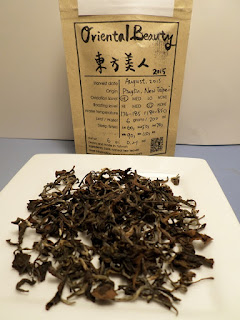
One subtle detail that always impresses me about Sanne Tea is the handwriting on the back label. The tea name including the oriental characters, and steeping parameters are all filled in by hand for each package. Lulu is an artist with a heart for detail.


Looking at the leaf, (2014 on the left) both show all the correct colors of brown, red, green, white, and yellow. I think the yellow is the most difficult to catch in all the leaf of this type I have reviewed. Even though it appears just the opposite in my pictures, the 2015 version seems overall darker. It also seems fluffier but that may be simply a settling thing, still this is what I noticed.

Both samples have a light roasty, lightly malt, and fresh scent.

Until disaster struck, my intention was to brew these in identical mugs then pour the brew into smaller cups. This would allow me to literally compare them side by side. Now I find myself in need of both mugs for the one cup. After the panic, I realized I had other options. Since I used the entire sample all I could think of was how do I save this mug.

The 2014 Oriental Beauty liquor is caramel in color. The taste is honey with a  vibe similar to muscat grape. The aftertaste is lingering, sweet, and a combination of fruity and floral. There is a slight rough textured bite. It is not unpleasant and certainly not bitter. Just before it drifts off into the aftertaste I get a neat leafy hit - I can think of no other way to describe it. This is a solid cup of tea.

While steeping the 2015 Oriental Beauty, I noticed an amazing aroma . Maybe the previous sample had the same wonderful scent and I missed it. I also noticed this is much lighter in color. It is a dark honey color. Hmmm. The taste is extremely close to the previous year. It is honey with muscat grape. I am also getting the combination of fruity and floral in the lingering aftertaste. The difference between the two is this one does not have the rough textured bite. It is simply smooth. The leafy taste just before the aftertaste kicks in, is also reduced.

I really think it is too close to call which is better - especially given my faulty comparison. It is likely that I steeped the first mug longer than I thought. This would easily explain the differences.

What I learned is both teas are very good and both will take panic and bad technique in stride. Tune in next time for another exciting episode of tea brewing disasters! Even those of us who brew a lot of tea, have those days, more often than I care to admit.

You can find Sanne Tea 2014 Oriental Beauty here

You can find Sanne Tea 2015 Oriental Beauty here

Friday, October 30, 2015

Oollo Tea, Oriental Beauty

Oollo Tea Description:
Renowned for its beautiful five colour dancing leaves. This traditional beauty exudes apricot and peach scents followed by indulging orchid, muscat grape, and apple flavours.

Origin:
Varietal: Qingxin Oolong/Jinxuan Oolong
Grower Name: Zhen Family
Location: Pinglin, New Taipei, Taiwan
Elevation: 500m
Harvest: 2014 Spring

Sample provided by Oollo Tea

My Review:
Today I was delighted to read up on this tea and learn its secret is Vampires! More on that in a moment. First, something else I learned reading Oollo's website; Oriental beauty is the name British royalty assigned to this tea for it's "beautiful colours and shapes. It seemed like a lady dancing in the tea pot".

What gives this tea its unique characteristics is the green leaf hopper that bites the leaf and feast on the tea leaf juices like vegetarian vampires. Seems totally appropriate on the day before Halloween.

I have a 5g sample in a sealed aluminum bag. The label has brief brewing instructions. There are expanded options on the website.

Opening the bag at first gives up very little in the way of aroma. Then I catch floral notes that seem to grow as I linger. Oollo mentions orchids. To me it was more reminiscent of peony.

The leaf is gorgeous. The five colors associated with higher quality leaf can be seen - brown, red (more of a cinnamon), green, white, and looking closely, touches of yellow. The yellow/white is the result of the vampire biting leaf hopper.

I decided to use the entire sample for a western steep. I was originally going to split it for a gung fu session - until I read about the dance of the leaf that caught the British royal's attention.

Never wanting to miss a good dance, I heated water to 195F and grabbed my clear glass Bodum press. The steep was a short 1 1/2 minutes. So I guess I am back to doing a hybrid method from years passed, where I use western water amounts and eastern time and temperatures. Seems to work for me.

As for the dance, most of the leaf hung vertically from the surface. A few leaf dove to the bottom. What made this interesting was not the ballet I was expecting, rather the slow graceful swelling of the leaf as it began to fill the pot. There were several leaves that gyrated and twitched. I don't know, maybe they were Miley Cyrus wanna bes. Forget it, scratch that image. I know. Too late.

The steeped leaf is mostly complete leaves and buds joined to stems. From this side of the steep, I see no evidence of the work of the green leaf hopper. The scent is honey and fruit.

The liquor is clear, bright, and more the color of syrup than my camera captured. It is kind of a honey/caramel.

Tasting, I am asking, are you sure this is oolong? I know it is on heavily oxidized end of the scale but this seems like a Nepal black tea. It lacks the heavy roasting that many dark oolongs possess and for that I am glad - not personally a fan of heavy roasting.

So what I am tasting is raisin drifting into muscat grapes. It also has a nutty, deep woods presence to it. Late in the sip I sense it opening up with floral notes. Again, to me, it is peony. Very good. I am still making a Nepal/Darjeeling comparison in the flavor.

This should go several more steeps. I may find out later today. Right now an earache and head cold are making me feel less than up to the task. It has to be couch time somewhere, right? Definitely aspirin time.

You can find Oollo Tea American Beauty here.

Monday, October 19, 2015

What-Cha, Vietnam Red Buffalo Oolong

What-Cha Description:
A brilliant oolong tea with a creamy smooth texture and delightful honey taste.

Sourced by Geoff Hopkins of Hatvala, who regularly travels Vietnam in search of the best teas, all of which are sourced direct from the tea producers.

It is Hatvala's mission to raise awareness of the high quality Vietnamese teas which are often overlooked on the world market and it my pleasure to assist by making Hatvala's full range of Vietnamese teas available on What-Cha.

Sample provided by What-Cha Tea Redefined

My Review:
So today I am reviewing the last of the What-Cha samples I received from Alistair. My first review came as What-Cha was the new kid on the block. A year later they appear to have established themselves as a force to be reckoned with in the tea world. I love that they offer teas from around the world, places that I didn't even realize grew tea. I have loved almost everything I have tried from them. I also found that when I asked a question, if Alistair didn't know the answer already, he was willing to dig in to it to find out the answer. So, thank you What-Cha. Much continued success!

Beautiful nuggets
The sample is packaged in a resealable aluminum pouch. The suggested brewing parameters are clearly labeled on the front of the bag.

Opening the bag, I am met with a rapid fire hit of three aromas. The first passed before I could identify, though it was familiar. The second was a touch of a roasted scent. The final, well, it reminded me of a certain smell that often came from a room down the hallway in my college dormitory. Not sure what it was but the guys all coughed and laughed a lot ;)

The leaf is rolled into nuggets typical of oolong, except for the unusual color. I lightened the photo so you could see it better. It is very dark, almost black, with cinnamon streaks. It looks like some one rolled a Dian Hong. Just looking at it, this is a hit with me. (rolled, hit, college - I so amuse me)

Lovely fall colored mug
I  followed directions by steeping for 2 1/2 minutes at 203 F. The nuggets quickly began to expand. The leaf didn't so much dance in the water as it relaxed and stretched. At the end of the steep. looking into the glass pot was a bit like looking into a dark cinnamon colored jungle.

The result is a nifty fall colored liquor. It is bright, clear, and glowing. It reminds me of the colors outside my window today.

The steeped leaf has an aroma that again is familiar but I can't quite recognize. It kind of reminds me of grape jelly, honey, and brownies - kind of. Anyway, it smells good.

I poured the leaf out on a plate for a better look. The color is very neat with brown, cinnamon, and olive greens. The thing that caught my attention was the pile of leaf, through the camera, looked like a dragon on the plate. No college joke here. It is called pareidolia. It is when the brain tries to form a recognizable pattern, like faces in a cloud. So, bonus points for random dragons.

I don't see a buffalo, I see a dragon!
Once I take a sip, I am confused for a moment. This isn't like a typical oolong. It isn't black tea. It doesn't remind me of a green.

There is absolutely no bitterness. I am not noticing much if any astringency (drying).

You can tell words aren't coming to me. The taste is much lighter than I expected. I have gone through my reviews of oriental beauty and Bao Zhong teas, thinking maybe this was similar to those teas. Nope.

There is a woodsy taste. It also reminds me of stone notes, like stream water that has rushed through stones. It doesn't have a strong roasted note but more hints. It is honey and malt, yet only lightly.

I really hate that for my last What-Cha supplied review, I can't come up with a better description. On the other hand, it makes for a good mystery. Maybe you will be inspired to find out for yourself, the secret of the red buffalo.

You can find What-Cha Vietnam Red Buffalo Oolong here.


Friday, October 9, 2015

Sanne Tea, Taiwan No. 18

Sanne Tea Description:
Sun Moon Lake is Taiwan’s main base for the cultivation of No.18, a black tea strain, also called Hong Yu (Ruby), only grown in Taiwan. In 1999, No.18 was created by hybridizing Taiwanese wild mountain tea trees with Burma Assam tea trees, and grown in the special climate of Yuchih Township, where Sun Moon Lake is located. The trial planting was so successful that No.18 became the signature tea of the lake area.

Similar to Assam tea and Ceylon tea, No. 18, when brewed, has a bright red color and strong, rich flavor with refreshing pungent notes. The tea also has a natural cinnamon and mint fragrance, a feature of the Taiwanese wild tea strain. This distinctive tea is the perfect combination of Indian and Taiwanese Black teas.

Sample provided by Sanne Tea

My Review:
One of the dangers of tea blogging is the amount of teas in the collection at any given time. Occasionally, one ends up at the back of a box in the bottom of the stack of boxes and gets overlooked. That happened with this one. When I stumbled upon it I had to wonder how could this happen, especially when it is clearly labeled as coming from Sun Moon Lake. There are certain growing regions that almost guarantee I am going to be moved. Sun Moon Lake is one of them.

Normally when I  think of Taiwan tea I think oolong, but Taiwan also produces some excellent black teas.

This 5g sample came in a resealable pouch. The front is simple and clean. The back list quite a bit of information, that as I have recently learned, has all been handwritten with a brush pen. Sanne Tea goes above and beyond in this regard. You can expand the picture to get a more complete idea of what information is included. One that I appreciate in particular is the leaf to water amounts.

OK, let's prepare some tea...

First comes the sniff test. Wow. It's mainly cocoa and malt. It kind of has a baked aroma. It is not really brownies. Maybe sweet potato mixed with the cocoa and malt. There is another element that reminds me of almost a Darjeeling like grape. To Amanda of Rambling Butterfly Thoughts this note was more of a sassafras with menthol. However your brain and experience translates it, I think we can all agree it smells amazing.

The leaf is eerily gorgeous. Maybe it just strikes me this way as we just set out some Halloween decorations, but the long slender twists of leaf look kind spider leg like. ha. Seriously though, the leaf is very dark. The picture doesn't do it justice as it was hard to photograph.

I used the entire 5g sample per directions in 205 F water and steeped for a short 60 seconds. The result is a classic hearty ruby red brew. Again today my picture isn't catching the essence of the mug. Here it looks more orangey/brown. It is a far deeper and more beautiful color in person.

The taste is similar to the dry scent. It is a mix of honey, cocoa, malt, and sort of sweet potato, though the sweet potato is not as obvious as in some Chinese Dian Hong teas. The sip builds to a solid peak. I hesitate to call it bite. Despite the varietal being a mix of assam and wild Taiwanese trees, this does not have the strong bite of an assam, rather it is more a presence that asserts itself gently but with some authority. I can still taste and smell what to me is a muscatel type note as well.

The second cup was steeped for 90 seconds. The now cinnamon brown leaf smells much more of sweet honey. The brew color is even a deeper red. The taste also seems sweeter and in some ways more mellow. It feels thick and syrupy on the lips.

I am also getting an interesting sense of candy. Like cinnamon candy without the burn. While it is light and fleeting, I experienced the sensation a few times before deciding to comment. Underneath the honey, cocoa, and cinnamon, I am still lightly catching the leafy grape notes.

This is a delicious and complex tea.  

The label lists this as capable of 5 steeps. From previous experience with this type tea, I fully believe it, however, this is as far as I have time to devote today. Let me add, as a reviewer, I often have to suspend my own preferences and try to understand what the tea is meant to be and how well it achieves it. I love it when I review a tea that 'fits' my personal tastes. This is one such tea. I don't have to work at understanding it. I can simply get lost in the wonderful experience from first sniff to last drop. Much love for this one Sanne Tea!  

You can find Sanne Tea Taiwan No. 18 here.

Thursday, September 10, 2015

Oollo Tea, Baozhong Oolong

Oollo Tea Description:
Grown in the serene mountainous terrain of Wenshan, Taiwan. The twisted leaves produce elegant lilac and vanilla fragrances while developing delicate sweet, floral notes. 

Origin
Varietal: Qingxin Oolong
Grower Name: Zhen Family
Location: Pinglin, New Taipei, Taiwan
Elevation: 500m
Harvest: 2014

Sample provided by Oollo Tea

My Review:
I feel like I have abandoned the blog lately. This is only the second review this month. No, I haven't been sick. No, I haven't moved on. Mostly it has been so blasted hot all month. 90 F + everyday does not equal a great desire for hot tea. Mostly, I have been chugging gallons of a bottled green tea. Don't judge me.

Today, the temperature broke and it will cap out around an awesome 80 F. So, that is reason to celebrate with tea and a review.

The sample I received has a clear and simple label. The sample is not resealable. It appears to contain about 10g of leaf.

My first clue as to what to expect came when I cut open the bag. I literally said, "Oh, Wow!" out loud. This is wonderfully fragrant of lilac. As I enjoy the scent the floral aspect lowers and I start catching sweet field hay. Truly nice.

The leaf is large, and twisted, with various deep shades of green. The leaves are attatched to the stems. I thought I knew Baozhong, but this is fresher, more alive, in appearance than I have experienced before.

Today I will once again employ the use of my favorite brewing instrument, a Bodum French Press. I love it and would with out question buy another if an unfortunate mishap should befall it.

I used a cup of filtered water heated to 185 F along with half the sample (about 5 grams of leaf).  I let this steep for 2 minutes. The label range is 1.5-4. I almost went the four minutes because I probably won't have time for the 3 cups this should make.

The leaf stayed pretty much on the surface of the water and only partially relaxed. No dancing for these shy leaves.

The resulting cup color is liquid gold. The picture definitely does not do it justice.

The cup aroma is sweet lilacs and after reading the company description, I can agree with vanilla notes.

The taste is softer than the scent suggests. At first I think a longer steep should have been used. As I adjust and the cup cools a little this opens up. The floral aspect is met with a delicate spice that almost has me rummaging through the wife's spice cabinet to figure out what it could be. Without doing that, because my wife would be upset with me, the best I can imagine it, is a custard and nutmeg combination done lightly and elegantly. The aftertaste lingers with a classic Taiwan oolong vegetal taste.

There is not an hint of bitterness and no astringency. No smoke. No roasted notes. Nothing even remotely off. It is sweet tasting and creamy feeling. This is really a pleasure to drink. Very nice.

You can find Oollo Tea Baozhong here.

Tuesday, August 18, 2015

Sanne Tea, Bao Zhong

sample front

Sanne Tea Description:
The tea comes from Pinglin area, one of the oldest tea regions in Taiwan. The tea farm is in Cuku, Pinglin District, near the Feitsui Reservoir area. The environment is strictly protected in this area. Though other areas also produce Bao Zhong Tea, this Bao Zhong Tea, also called Wen Shan Bao Zhong Tea, is recognized as the best quality and the best fragrance.

Fragrance is the key to determine the quality of Bao Zhong Tea. High quality Bao Zhong Tea has a clean, elegant, rich and generous floral scent. The best way to fully enjoy Bao Zhong Tea is to inhale deeply the intoxicating fragrance before drinking. The tea has an after-drinking sweetness blended with hints of gardenias and refreshing flavor surging back up to your nose. The leaves of Bao Zhong Tea have a natural twist and are bright blackish green with a light golden color on the tips. Our Bao Zhong Tea leaves also show grey/white dots, a feature of the highest quality. When brewed, the tea liquor has a clean honey yellow color with a touch of pale green.
sample back

Our handcrafted tea was harvested and made in April, 2015. All tea leaves were from an organic tea farm, and 100% handpicked. The tea workers only picked the well-grown tea leaves, which contain sufficient nutrition to generate exquisite flavors. After harvest, the flesh tea leaves were naturally withered under sun and gentle breeze. Compared to blower withering, natural withering keeps the tea’s innate aroma. These teas are mildly fermented and only lightly roasted to preserve the fresh, lush nature.

Sample provided by Sanne Tea.

My Review:
I have tried Bao Zhong a few times and liked it. So, going in to this review I expect to enjoy the cup. I included two pics of the sample bag. The front is a simple minimalist design. The back contains a lot of information. Rather than going through the details, you can click on the picture to enlarge. I personally thought the back was kind of cool. The information appears to have been hand written on the bag with a Sharpie.

I opened the resealable bag and inhaled. The scent is at first subtle but opens up while lingering. It is sweet fresh cut field grass that takes on that slightly sour aroma of fresh hay. I am enjoying it.

Removing half the leaf (abt 3g), I am surprised by the color. If memory serves me correctly, this is far more green than what I have experienced in the past. What appears to be whole leaves, are withered and lightly twisted. The color ranges from that fresh spring green to an almost battleship gray. I also notice tan tips and some white. Interesting and nice looking leaf.

I put the leaf in my clear glass press, then looking at the bag noticed Sanne Tea recommends 6g per cup. Well that is twice what I would normally use but into the press goes the rest of the sample. I probably would have been fine doing a western style brew my way, but the bag has directions for short steeping times, so I went with it.  The water was heated to 198F which is roughly in the middle of the range. The first steep is a short 40s.

Pouring, I notice how light and yellow is the liquor. A cheap point and shoot camera with bad lighting doesn't do this justice. It is so bright and clean looking. Very nice.

Lifting the cup, I breathe in a wonderful floral aroma. Generally speaking, I am not a big fan of oolong as most that are popular in the west are heavily roasted and highly oxidized. This is just the opposite. Sanne Tea notes the aroma as similar to gardenias. I personally have not sniffed gardenias so I can't say. To me, it is very similar to Taiwan Alishan teas I have tried. A really clean and inviting aroma.

Tasting, it is sweet. This reminds me of corn. It is very clean and refreshing like spring water. Mid sip I again notice the floral notes. None of the flavors are overpowering. This is an excellent afternoon tea to sip, relax, and meditate on the cup or the moment. It has a lingering green viney aftertaste.

Sanne Tea gives parameters for 6 steeps. I don't have the time for going the full length on this one. That said, my cup is now empty and I am still craving more of this so steep two is at 30s.

Cup two has the same color as the first. Same wonderful aroma. The flavor is more green leaf like than corn and there is a spice note that kind of bounces towards peppery then backs off. Feels thick milky except with a slightly rougher texture.

Bao Zhong is also Pouchong, so maybe you have tried it under one or the other names before. This one just strikes me as different. Maybe I need to pull out some of my other samples to be sure, but this one just feels richer and has more life than I remember. A very nice tea.    

You can find Sanne Tea Bao Zhong here.

Monday, August 17, 2015

What-Cha, India Darjeeling 2nd Flush Goomtee Oolong Tea

What-Cha Description:
A delightful oolong tea which evolves and develops with each subsequent brew. A great fruity nose with a complex taste of orange and spice.

Sample provided by What-Cha Tea Redefined.

My Review:
I'm having a blah day. I knew I had not written many review posts lately - I will say the matcha reviews took an extraordinary amount of time to test, photograph, write, edit, and post, but really like most people summertime is just not prime hot tea weather. I forced myself to grab one out of the box today. Turns out What-Cha is just the treatment I needed to fight the summer tea blahs.

As with all What-Cha teas I've reviewed, this is a 10g sample in a resealable aluminum zip lock bag. The label is simple and to the point. It tells me what I need to know including a description and a best by date.

I opened the bag and my blahs went scurrying over the hill. I held the bag to my nose several times. So sweet. So spring flowers. I finally decided it has the aroma of a bouquet of peonies. Let's see, I could continue smelling this or...

Removed about 3g of leaf. It is as pretty as the aroma. The lightly twisted leaf has streaks of red and browns, along with some silvery white tips. So glad I grabbed this already today.

I used my clear glass Bodum press with water heated to 195F. I let this steep for 3 minutes per the label instructions. The leaf did not move much at all during the steep. I won't hold the lack of dance against it. I can't dance either.

As always with a Darjeeling, I am surprised at how light in color it is when poured. It looks like old fashioned ginger ale without the bubbles. I wish I had better photography skills to capture the glow of the cup. It is liquid sunshine.

The scent of the wet leaf is intoxicating. It reminds me of peaches, no wait, it's grape, I mean orange. Yeah, it is like that.

Tasting, I first notice the muscat grape notes, along with touches of malt. Beyond this it, at first, grabs me as fresh mountain stream water. Then I notice fruity notes that lightly suggest orange. I am not able to identify any spice notes as mentioned in the description. I'll chalk that up to different brewing parameters.

This is a gentle, relaxing cup to meditate upon. At the same time, I found it invigorated me. It definitely took away the blahs. Since I waited so late in the day to get started, I am going to have to break for the evening meal. I hope afterwards to pick up with more cups as this is really an enjoyable oolong.

You can find What-Cha, India Darjeeling 2nd Flush Goomtee Oolong Tea here.

Monday, July 27, 2015

Oollo Tea, Milky Jinxuan Oolong

Oollo Tea Description:
The true milky Jinxuan oolong tea with natural cream milk accent and luscious texture. The Alishan family farms tea trees that were bought from our family in 1990. They practice zero pesticide natural farming.

Origin
Varietal: Jinxuan Oolong
Curator: Grandpa Lo
Location: Alishan, Jiayi County, Taiwan
Elevation: 1200-1800m
Harvest: 2014 Spring

Sample provided by Oollo Tea

My Review:
The brief cool spell has ended way too soon. We are back to heat and humidity. O well, at least my air conditioning is working today. Being as I am all cool and comfortable, it must time for tea.

Today's choice is a milky oolong from Taiwan. I haven't had one of these is a long while. The sample cannot be resealed. Sometimes I use tape but more often a paper clip to hold the bag closed. It won't keep long this way and will need to be steeped soon. The label is simple with pertinent brewing instructions.

Opening the bag, I get a sweet scent of cut and dried field grass. It also leans towards a touch of bread and malt, but just a touch.

The tightly rolled leaf is dark and for some strange reason looks like armor to my brain. I think it is because of dull dark grayish tint and the texture looks kind of like a ninja turtle shell. Yeah, even I think that description is a little off the wall.

Into the press it goes along with 195 F water for a 3 minute steep. The range on the label is 1.5 - 5 minutes. That's a pretty wide range.

Before I write about the liquor or the taste, I have got to mention the wet leaf. Look at the size of it! I have trees in my yard that don't have leaves this big. I am impressed.

Most of the leaf after the first steep is still fairly compressed but as you can see some of it couldn't wait to get out of that tight little ball.

The aroma of the wet leaf is lightly roasted, slightly sweet, and vegetal.

On to the brew!

The tea has steeped very clear and very yellow. It is quite a pretty cup.

The first sip is, at first, light in flavor and texture. It starts with a mineral note that is almost metallic. It quickly morphs into a smooth milky texture. It is very thick feeling. Next, I catch a sensation that I can't think of another way to describe except to say prickly. The problem with saying this is it sounds unpleasant but that is not the case here. As you swallow, floral and vine notes emerge.

There is zero bitterness, but it feels kind of drying. As I think about the taste, I realize I caught hints of the roasting. They don't dominate or even jump out at you. I like the subtle layering of the flavors.

Interesting. The more the cup cools the more I am actually catching a milky taste to go with the texture.

Oollo says this the leaf can be re-steeped to make 4 brews.

You can find Oollo Tea, Milky Jinxuan Oolong here

Thursday, June 11, 2015

Oollo Tea, Alishan

Sample
Oollo Description:
From the world renowned Alisan Mountain comes the unpretentious high mountain oolong. The Alisan family farms tea trees that were bought from our family in 1990. They practice zero pesticide natural farming.

Origin:
Varietal: Qingxin Oolong
Curator: Grandpa Lo
Location: Alisan, Jiayi County, Taiwan
Elevation: 1200-1800m
Date: 2014 Winter

Sample provided by Oollo Tea

My Review:
I do not want another month slipping by without reviews. So let's get started.

Dry Leaf
It is a scorcher here today with highs hitting the low 90's F. I want something that sounds light and refreshing while having solid flavor. This Alishan spoke to me saying it would fit my desire.

As you can see in the sample picture above, the packaging is a sealed aluminum bag. The label is simple and clean, showing basic brewing parameters. The one thing I notice, the label shows 5g in the brewing section, however Oollo's website calls for 3g for 12oz. The website more closely matches how I like my tea.

Opening the bag, I don't find much in the way of aroma to suggest what is to come. There is a light dried field scent and a touch of corn aroma. The leaf is quite dark green. I actually lightened the dry leaf picture some so the leaf would be easier to see. It is tightly rolled pellets with a partial exposed stem.

Wet Leaf
I used my glass press as the brewing vessel of the day. The water was heated to 195 F. With the lid in place, I steeped for 2 minutes.

The liquor is golden yellow with just the lightest tint of green. It is as clear as our extreme hard water will allow.

The wet leaf expanded nicely to reveal two or three whole leaves on each stem. It always amazes me how the artists process all that leaf into that tiny pellet by hand.

The wet leaf has a roasted aroma. I was expecting it to be more floral. Let's see where the sip takes us.

The first taste starts with a spiciness that is sort of a combination of mint and cinnamon. Not really the taste, rather the feel. It is icy and hot at the same time. This passes into the floral notes I was expecting. This one, however, is a little different, as it doesn't knock you over with floral. To me, that fits perfectly on this hot day. I am also tasting some creamy corn notes.

My wife popped in during my tasting asking me to help her plan some things unrelated to tea. While I am helping, I noticed how long the aftertaste was lingering. Nice.

I like Oollo's description of unpretentious, as that fits perfectly. It is not a wallflower, but it is not trying to be the center of the universe either. It does not knock you over with floral and does not have that strong latex aftertaste some green oolongs possess. What you get here is a solid cup of alishan with sufficient depth to keep you interested. For me personally, the cooler it got, the more I liked it. This leads me to believe it might work chilled.

Like most oolongs this should resteep well.

You can find Oollo Tea, Alishan high mountain oolong here.

Saturday, April 11, 2015

Sanne Tea, Dong Ding Oolong

Sanne Tea Description:
Dongding Oolong is one of the most famous Taiwanese teas. Most people know that Dongding Oolong Tea is grown in Lugu Township, Nantou County. However, in fact, only the tea grown in Yonglong, FengHuang, and Zhangya Villages in Lugu Township can be called "Dongding Oolong".

This farmer's family lived in FengHuang Village for generations. His Dongding Oolong has won several prizes in Taiwanese Dongding competitions. The tea was baked with Longen in a light baking process, perfect for multiple brews. The tea leaves were rolled in a semi-sphere shape and have deep green color. When brewed, the tea is light amber almost golden color.

Sample provided by Sanne Tea

My Review:
Sanne Tea, as of this writing, has not officially opened their doors for business. This sample was sent for review and feedback.

The sample arrived in a small resealable pouch. It is foil backed with a clear plastic face. Suitable for temporary storage or far away from light. The sample was enclosed in a pretty cardstock envelope that gave it added protection in storage and shipping. Also included was an information card listing all kinds of things including the harvest date and cultivar.

The leaf is typical hand rolled nuggets of leaf with partial exposed stems. When I say typical, I mean that with great respect. Once you see the size of the leaf and stems, you have to be in awe of the talent of the artists who hand roll each nugget.

I used the entire sample. I am not sure how much was in it. I do think I could have used only half but chose not to do so. The leaf was placed in my freshly cleaned clear glass teapot where the nuggets soaked up the moisture left in the bottom.

With all the information provided there was not any brewing instructions. This is a lightly roasted oolong so I decided upon 200 F and a one minute steep with 5 ounces of water.

As you can see, after just the first steep the pot was very full of leaf and they have not even fully relaxed at this point.

I poured the liquor into my cup and noticed it is far more yellow than Sanne Tea's description of amber almost golden.

I forgot to mention how floral the dry leaf smells. Really, I am not a fan of highly roasted oolong, which is what I originally expected. This is lovely. Just the wonderful aroma is making me hungry. After steeping it is only intensified.

Oh, I love the taste. I am not really catching a roasted note at all. Instead, I am catching the orchid like floral notes, followed by a passing buttery popcorn flavor. There is also a spice note hanging out, more in the background, that I can't quite identify. I think it is along the lines of nutmeg. Very nice.

There is no bitterness or rough edges to this tea. Maybe a slight drying, but I am pretty immune to such things so it is a bit of a guess. The aftertaste grabs and lingers with that viney note I always call geranium.

I could drink this often. To my tastes, this is what oolong should taste like.

The second cup was also steeped at one minute. It is a little darker and leaning more towards golden in color. I had to abandon the cup before it cooled because time got away from me. While hot, the flavor was a lot less complex and more plant like than the first cup. The flavor was pretty intense so I know it would steep more times. I just can't tell you how it will taste. The first cup though was fabulous.


Friday, March 20, 2015

Simple Loose Leaf, Sheng Cha Oolong

Simple Loose Leaf Description:
Sheng Cha is an oolong tea grown at 1,100 m elevation and is grown wild.  Sheng Cha is made from tea plants left to grow for decades in the wild, this imparts a more earthy palate to the leaf.  Look for notes of sesame seed biscuits, toast and wheat.

Sample provided by Simple Loose Leaf

My Review:
Another short break from my white tea extravaganza. Today we will be looking at a tea I had not heard of before this sample. Sheng Cha. Sounds like a raw puerh. Instead this is an oolong. It does not say as much on Simple Loose Leaf's site, but I believe this tea comes from Taiwan.

The top removed from the resealable pouch causes me to ponder what I am smelling. After a moment I decided it was like the tops of strawberries. It is more than subtle, but not enough to think scented.

Scooping out a spoon of leaf, this looks like typical tieguanyin nuggets. Mainly dark green, with lighter green highlights, and a stem that reminds me of a polliwog tail.

The nuggets look deceptively loosely packed. Turns out they are hiding some massive leaves.

My Bodum press was called into service for this session. I wanted clear glass and lots of room. The press was warm and wet as I added the leaf. The damp aroma was a lot like an American biscuit.

Simple Loose Leaf's steeping parameters offers a range on the temperature from 185 F to 200 F. I used 194 F filtered water, and the 2 minute steep as called for by Simple Loose Leaf.

While steeping the nuggets fizzed, like a carbonated beverage. Pretty cool to watch. The leaf was in constant motion. It was sloooow motion but movement none the less. The leaf slowly began to unfurl. It wasn't until after the liquor was poured into the cup that I realized just how huge the leaf actually was that was packed in those nuggets.

After the first steep most of the leaf was still only slightly relaxed. The wet steeped leaf has an aroma that has again changed. It is kind of a baked bread scent with very light touches of strawberry and apricot marmalade. Slightly stronger is the aroma of light roasting and the floral notes of oolong. It is an interesting mix.

The color of the brew is like that of white grape juice. It has a light fruity and floral scent. The taste is a little of an eye opening, "O Wow!" moment. Not because it is the most amazing tea I have ever tasted, but because of the quick succession of flavors that shoot by. I doubt I caught them all.

First, I tasted biscuit and baked bread, then fruit. Again it reminds me of strawberry tops. I have not seen any other reviews that caught this same note, so it is just for me, and I appreciate it. The next flavor to fly by is a brief moment of walnut shells. Then it settles into a fruity and floral oolong flavor. Mixed throughout I catch brief roasted notes.

It is interestingly kind of tart leaving a little tingle around the lips and gums. It is also a bit sweet. The feel is a bit milky or almost foamy. It is a very curious cup. I can't quit tasting and analyzing.

The second cup calls for 1-2 minute steep. I chose 1 1/2 minute. The flavors seem to follow the first cup pretty close with maybe a touch more tingle.

This is a cool, need to try it, tea. I have read several reviews. All of them have been positive and all of them have interpreted it differently. I expect minor differences but this is all over the place. I find that fascinating.

You can find Simple Loose Leaf, Sheng Cha Oolong here.


Friday, March 13, 2015

Tea Ave, Tie Kwan Yin Oolong

Tea Ave Description:
The story behind Tie Kwan Yin Oolong goes something like this: Many years ago, a tea farmer from Anxi, China, discovered a tea that he took a special liking to. He named it Tie Kwan Yin, drawing from his Buddhist beliefs that the tree was a gift from the Goddess of Mercy, Kwan Yin. Fittingly, as the trees grow, they give off a pleasant aroma reminiscent of iron (tie).

Our Tie Kwan Yin Oolong is grown in Taiwan, not China, where many merchants who offer the tea source it. The terroir, or growing climate and soil conditions, of the Muzha district of Taiwan enables the trees to flourish, growing into a unique, distinctive-tasting tea. With a rich, deep flavor and a subtle bitterness, our Tie Kwan Oolong is pleasantly balanced by mellow, fruity notes, with a touch of sweetness. An opulent, distinct tea, Tie Kwan Yin is a favorite among oolong drinkers in Taiwan. 

Leaves are reddish brown and curled into balls. Tie Kwan Yin Oolong is an MOA organic tea.

Sample provided by Tea Ave

My Review:
One more oolong review before returning to our white tea extravaganza. This is the third sample from Tea Ave. The first two were excellent. Let's see if the trend continues.

This is a moderately roasted Tie Kwan Yin. It is listed as a 5 out of 10 on the roasting level while being a 5-6 on oxidation. When I opened the bag I half expected to be blown over by roasted notes. I was more than pleasantly surprised. I am also beginning to think Tea Ave is messing with me (just kidding). The roasted note is the strongest scent but I also catch fall leaves and a grape like scent. At least that is how my brains interprets the aroma.

I also was expecting the leaf to be the typical deep green shades. This one looks like a tippy black tea rolled into nuggets like an oolong. I am intrigued.

The gaiwan brewing method on the label recommends 2.5 grams of leaf for 110 ml gaiwan. I will be using a 90 ml gaiwan and the awesome aroma cup set I received from Tea Ave with the samples.

I heated the water to 200 F (95 C) and poured it into the tasting cup and then the aroma cup, to warm them, before pouring it into the gaiwan. The steep time was 3 1/2 minutes. Tea Ave recommends 3-5 minutes. That seemed long for a gaiwan but I went with it.

I used the gaiwan to fill the aroma cup, then covered it with the tasting cup. After a few moments I turned the set upside down and slowly lifted the aroma cup to fill the tasting cup.

The aroma cup is then used to catch the scent of the tea. I am not an expert at this method yet. I was mostly getting the roasted notes. I was kind of hmmm at this moment. Then I pulled the aroma cup away and immediately caught a rush of a floral bouquet. I don't know if it was from the wet leaf or the tasting cup. I just know I liked it.

The liquor is light apricot in color. Except for the leaf bits I let escape the gaiwan, the liquor is clear and bright.

The wet leaf is still partially holding onto its rolled shape. It looks like cooked spinach in the gaiwan.

In tasting, I am getting the roasted notes first and they are dark and nutty. Not at all overpowering as I feared with the long steep time. Beyond this I am getting a creamy sensation. I do not recall seeing this mentioned in any other reviews. This is not at all bitter. There is a slight bite. A sweetness runs throughout the sip. Towards the end I notice floral and fruit.

The fruit notes remind me of apricot. The floral I can't narrow down to any one primary scent. It is kind of a greenhouse scent. One thing I notice is what I am not catching, even in later cups. Normally with a Tie Kwan Yin, there is an abundance of what I have always called geranium. Other reviewers with a less favorable opinion call it latex. However you normally interpret this element, I am not detecting it here except as a very faint trace in the lingering aftertaste.

You can find Tea Ave, Tie Kwan Yin Oolong here.