Showing posts with label Sanne Tea. Show all posts

Wednesday, November 4, 2015

Sanne Tea, 2014-2015 Oriental Beauty


Sanne Tea Description:
Oriental Beauty is also known as Bai Hao (white tips) Oolong, or Champagne Oolong. The beautiful name, many people believe, is from Queen Victoria. When brewed, the leaves generally spread in water, like a graceful lady dancing with gorgeous finery.

Samples provided by Sanne Tea

My Review:
What we have here is a side by side comparison of Sanne Tea's Oriental Beauty from 2014 and 2015. It should prove interesting to see if I can detect subtle differences from one harvest to another from the same farm.

Unfortunately, as it turned out, this will not be the comparison I wanted to present. Why? I was not paying attention. Simple as that. My intention was to follow the directions on the sample label - they are identical for both samples. The entire 6g sample of each was used in water heated to 180F. The first steep time was to be 60s. What I failed to check was the kettle was not empty when I added my 6oz of water (200ml). So, when I poured, before I realized, I had filled my 12oz mug. Since both teas need to be brewed with the same parameters to keep it fair, I now have to use more water in the second mug. I also lengthened the first steep to 2 minutes to compensate.

One subtle detail that always impresses me about Sanne Tea is the handwriting on the back label. The tea name including the oriental characters, and steeping parameters are all filled in by hand for each package. Lulu is an artist with a heart for detail.

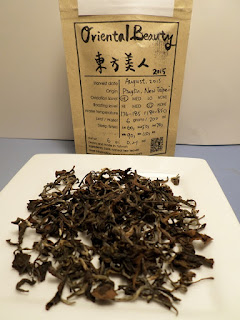
Looking at the leaf, (2014 on the left) both show all the correct colors of brown, red, green, white, and yellow. I think the yellow is the most difficult to catch in all the leaf of this type I have reviewed. Even though it appears just the opposite in my pictures, the 2015 version seems overall darker. It also seems fluffier but that may be simply a settling thing, still this is what I noticed.

Both samples have a light roasty, lightly malt, and fresh scent.

Until disaster struck, my intention was to brew these in identical mugs then pour the brew into smaller cups. This would allow me to literally compare them side by side. Now I find myself in need of both mugs for the one cup. After the panic, I realized I had other options. Since I used the entire sample all I could think of was how do I save this mug.

The 2014 Oriental Beauty liquor is caramel in color. The taste is honey with a  vibe similar to muscat grape. The aftertaste is lingering, sweet, and a combination of fruity and floral. There is a slight rough textured bite. It is not unpleasant and certainly not bitter. Just before it drifts off into the aftertaste I get a neat leafy hit - I can think of no other way to describe it. This is a solid cup of tea.

While steeping the 2015 Oriental Beauty, I noticed an amazing aroma . Maybe the previous sample had the same wonderful scent and I missed it. I also noticed this is much lighter in color. It is a dark honey color. Hmmm. The taste is extremely close to the previous year. It is honey with muscat grape. I am also getting the combination of fruity and floral in the lingering aftertaste. The difference between the two is this one does not have the rough textured bite. It is simply smooth. The leafy taste just before the aftertaste kicks in, is also reduced.

I really think it is too close to call which is better - especially given my faulty comparison. It is likely that I steeped the first mug longer than I thought. This would easily explain the differences.

What I learned is both teas are very good and both will take panic and bad technique in stride. Tune in next time for another exciting episode of tea brewing disasters! Even those of us who brew a lot of tea, have those days, more often than I care to admit.

You can find Sanne Tea 2014 Oriental Beauty here

You can find Sanne Tea 2015 Oriental Beauty here

Wednesday, October 28, 2015

Sanne Tea, Taiwanese Green Tea - Cold Steep

In all the time I have been reviewing tea on The Everyday Tea Blog, I have never reviewed the same tea twice in back to back reviews. If I have something to add, I usually handle it by updating the original post. I am making an exception today.

Yesterday I reviewed a hot western steep of Sanne Tea, Taiwanese Green Tea. Today I am writing about a cold steep version of the same tea. The results are different enough to warrant a separate entry.

I love iced tea but for whatever reason I seldom cold steep tea. I'm not sure why, as it is incredibly simple. I grabbed a glass bottle that once contained some particularly mediocre store bought tea. I then placed 3g of loose leaf tea in the bottle, filled it with cool water, tightened the lid and placed in the refrigerator. The next day I have cold tea just waiting for me.

You can do this with any tea (even tea bags) or herbal. Some will work better than others. Experiment and have fun with it.

When I grabbed this today I decided to pour it into another bottle to strain out the leaf. I grabbed a funnel but never thought to grab a screen, so I got a couple leaves in the second bottle. In many parts of the world, they would not bother trying to strain in the first place, so its all good.

The color is a beautiful gold with light green tint. The taste is the reason I felt this deserved a new post. This is just simply delicious and refreshing. It is so sweet, I have no desire to use any additives. The first note that hits me reminds me of the first hot cup. It has a sweet corn/buttered popcorn flavor. Then I catch what seems to be a roasted hint, except this particular green tea was not roasted. So, maybe it would be better to call this a nutty flavor. Finally, I catch an abundance of floral notes reminiscent of Taiwan oolongs. It is a very nice orchid sweetness that carries on into the aftertaste.

As much as I enjoyed this tea hot, I have to tell you this tea really shines as a cold brew.

You can find Sanne Tea Taiwanese Green here.

Tuesday, October 27, 2015

Sanne Tea, Taiwanese Green Tea

Sanne Tea Description:
This Taiwanese Green Tea comes from Pinglin District, New Taipei City, near the Feitsui Reservoir area. For centuries, the environment has been strictly protected in this area. Mr. Chen, the fourth generation of his tea family, earned the organic certification in 2010, and became one of only 22 organic tea farmers in this area.

Unlike non-fermented Japanese Green Tea, Mr. Chen’s Taiwanese Green Tea is lightly fermented, about 5%, making the tea less pungent and less bitter than Japanese Green Tea. After it is picked, the fresh leaves go through a short withering process. Unlike other green tea makers who pick immature tea buds, Mr. Chen only picks the well-grown tea leaves, which contain sufficient nutrition to generate exquisite flavors. After harvest, the fresh tea leaves were naturally withered under the sun and gentle breeze. Compared to blower withering, natural withering keeps the tea’s innate aroma. Next step, the stir is the key for making excellent green tea. Insufficient stirring would make tea smell moldy and fusty; over stirring would lose the freshness of green tea. Only an experienced tea master can adjust the amount of time and temperature during stirring, extracting the correct notes from the fresh leaves to impart a wonderful sweetness.

Sample provided by Sanne Tea

My Review:
Sanne Tea invited The Everyday Tea Blog to review a few of their new products. I quickly jumped at the opportunity as the previous teas were very good.

Today's tea is a new Taiwanese Green Tea. Taiwan is noted for their exceptional high mountain oolongs. They also have some fabulous black teas (Sun Moon Lake I love you). Lesser known, especially in the west, are the green teas that did not hit the global market until the mid 20th century and most of us are just hearing about them now.

This is a 6g sample that came in a resealable pouch. It looks like brown market wrapping paper on the outside but is lined to preserve freshness. The package front is elegant in its simplicity.

The back of the pouch is what most catches my attention. The pertinent information is hand written with a brush pen. I find this personal touch and attention to detail refreshing in a world of shove it out the door. Taking the time to do it right is very tea.

Opening the pouch, I get just a light whiff of green. If I have to find a word, I guess grassy is the best choice.

I poured the entire sample on to a plate then divided it in half. 3g went into a glass bottle. I filled it with water and put it in the fridge for a cold brew test in about 12 hours.

Examining the remaining 3g, the leaf is large pieces, some lightly twisted, some not so much. The leaf is various shades of green with an abundance of white tips on the end of the leaf.

I used the glass French press as usual. Water was heated to 175 F and once added the steep was a short 60 seconds.

Permit me to run off on a brief rabbit trail, I have always read tea bags release the flavor more quickly than loose leaf. I just don't get that. I have never steeped a tea bag for only 60 seconds. I think it is more fair to say a tea bag releases most of its flavor in the first steep, reducing the usable number of steeps to one - two if you like weak tea. Loose leaf usually steeps multiple times, has a more complex taste, and often results in a different experience with each.

OK, back to this tea. The resulting liquor I found to be one of the yellowest cups I can recall. The product page calls it light green. Possibly the difference is they may have prepared this in a gaiwan and I used the press.

The steeped leaf has really been rejuvenated. They are big plump green leaves. The scent is between green vines and grassy.

Tasting the very clear liquor, I taste sweet corn. I was expecting more of a seaweed flavor, but my brain and taste buds are calling this corn. It is incredibly smooth with no hint of bitterness. I am not noticing much in the way of drying astringency. The taste turns even sweeter toward the end.

As it approaches room temperature the flavor is reduced and it becomes more of a fresh mineral stream taste. I still find it pleasantly refreshing. The aftertaste remains green and grassy.

The second cup was steeped for 90 seconds. The color of this cup does have a slight greenish tint. The aroma out of the press is far more nori (edible seaweed). This difference is an interesting example of my rabbit trail comment above.

Cool. The taste is also a 180 from the first cup. The taste is bold nori. There is just enough bite to be interesting without being bitter or astringent. The finish is sweet and grassy. I notice just a slight tingle in the cheeks. As the cup cools the bite subsides, though never disappearing completely. The taste remains a mix of seaweed and grass.

This leaf should stand up to three more steeps, and I still have the cold brew to comment about, but not today. It is my oldest son's birthday, so we are getting ready celebrate with him. However, I have enjoyed my time this afternoon with this one from Mr. Chen's garden. Thank you Sanne Tea.  

You can find Sanne Tea Taiwanese Green here.

Friday, October 9, 2015

Sanne Tea, Taiwan No. 18

Sanne Tea Description:
Sun Moon Lake is Taiwan’s main base for the cultivation of No.18, a black tea strain, also called Hong Yu (Ruby), only grown in Taiwan. In 1999, No.18 was created by hybridizing Taiwanese wild mountain tea trees with Burma Assam tea trees, and grown in the special climate of Yuchih Township, where Sun Moon Lake is located. The trial planting was so successful that No.18 became the signature tea of the lake area.

Similar to Assam tea and Ceylon tea, No. 18, when brewed, has a bright red color and strong, rich flavor with refreshing pungent notes. The tea also has a natural cinnamon and mint fragrance, a feature of the Taiwanese wild tea strain. This distinctive tea is the perfect combination of Indian and Taiwanese Black teas.

Sample provided by Sanne Tea

My Review:
One of the dangers of tea blogging is the amount of teas in the collection at any given time. Occasionally, one ends up at the back of a box in the bottom of the stack of boxes and gets overlooked. That happened with this one. When I stumbled upon it I had to wonder how could this happen, especially when it is clearly labeled as coming from Sun Moon Lake. There are certain growing regions that almost guarantee I am going to be moved. Sun Moon Lake is one of them.

Normally when I  think of Taiwan tea I think oolong, but Taiwan also produces some excellent black teas.

This 5g sample came in a resealable pouch. The front is simple and clean. The back list quite a bit of information, that as I have recently learned, has all been handwritten with a brush pen. Sanne Tea goes above and beyond in this regard. You can expand the picture to get a more complete idea of what information is included. One that I appreciate in particular is the leaf to water amounts.

OK, let's prepare some tea...

First comes the sniff test. Wow. It's mainly cocoa and malt. It kind of has a baked aroma. It is not really brownies. Maybe sweet potato mixed with the cocoa and malt. There is another element that reminds me of almost a Darjeeling like grape. To Amanda of Rambling Butterfly Thoughts this note was more of a sassafras with menthol. However your brain and experience translates it, I think we can all agree it smells amazing.

The leaf is eerily gorgeous. Maybe it just strikes me this way as we just set out some Halloween decorations, but the long slender twists of leaf look kind spider leg like. ha. Seriously though, the leaf is very dark. The picture doesn't do it justice as it was hard to photograph.

I used the entire 5g sample per directions in 205 F water and steeped for a short 60 seconds. The result is a classic hearty ruby red brew. Again today my picture isn't catching the essence of the mug. Here it looks more orangey/brown. It is a far deeper and more beautiful color in person.

The taste is similar to the dry scent. It is a mix of honey, cocoa, malt, and sort of sweet potato, though the sweet potato is not as obvious as in some Chinese Dian Hong teas. The sip builds to a solid peak. I hesitate to call it bite. Despite the varietal being a mix of assam and wild Taiwanese trees, this does not have the strong bite of an assam, rather it is more a presence that asserts itself gently but with some authority. I can still taste and smell what to me is a muscatel type note as well.

The second cup was steeped for 90 seconds. The now cinnamon brown leaf smells much more of sweet honey. The brew color is even a deeper red. The taste also seems sweeter and in some ways more mellow. It feels thick and syrupy on the lips.

I am also getting an interesting sense of candy. Like cinnamon candy without the burn. While it is light and fleeting, I experienced the sensation a few times before deciding to comment. Underneath the honey, cocoa, and cinnamon, I am still lightly catching the leafy grape notes.

This is a delicious and complex tea.  

The label lists this as capable of 5 steeps. From previous experience with this type tea, I fully believe it, however, this is as far as I have time to devote today. Let me add, as a reviewer, I often have to suspend my own preferences and try to understand what the tea is meant to be and how well it achieves it. I love it when I review a tea that 'fits' my personal tastes. This is one such tea. I don't have to work at understanding it. I can simply get lost in the wonderful experience from first sniff to last drop. Much love for this one Sanne Tea!  

You can find Sanne Tea Taiwan No. 18 here.

Tuesday, August 18, 2015

Sanne Tea, Bao Zhong

sample front

Sanne Tea Description:
The tea comes from Pinglin area, one of the oldest tea regions in Taiwan. The tea farm is in Cuku, Pinglin District, near the Feitsui Reservoir area. The environment is strictly protected in this area. Though other areas also produce Bao Zhong Tea, this Bao Zhong Tea, also called Wen Shan Bao Zhong Tea, is recognized as the best quality and the best fragrance.

Fragrance is the key to determine the quality of Bao Zhong Tea. High quality Bao Zhong Tea has a clean, elegant, rich and generous floral scent. The best way to fully enjoy Bao Zhong Tea is to inhale deeply the intoxicating fragrance before drinking. The tea has an after-drinking sweetness blended with hints of gardenias and refreshing flavor surging back up to your nose. The leaves of Bao Zhong Tea have a natural twist and are bright blackish green with a light golden color on the tips. Our Bao Zhong Tea leaves also show grey/white dots, a feature of the highest quality. When brewed, the tea liquor has a clean honey yellow color with a touch of pale green.
sample back

Our handcrafted tea was harvested and made in April, 2015. All tea leaves were from an organic tea farm, and 100% handpicked. The tea workers only picked the well-grown tea leaves, which contain sufficient nutrition to generate exquisite flavors. After harvest, the flesh tea leaves were naturally withered under sun and gentle breeze. Compared to blower withering, natural withering keeps the tea’s innate aroma. These teas are mildly fermented and only lightly roasted to preserve the fresh, lush nature.

Sample provided by Sanne Tea.

My Review:
I have tried Bao Zhong a few times and liked it. So, going in to this review I expect to enjoy the cup. I included two pics of the sample bag. The front is a simple minimalist design. The back contains a lot of information. Rather than going through the details, you can click on the picture to enlarge. I personally thought the back was kind of cool. The information appears to have been hand written on the bag with a Sharpie.

I opened the resealable bag and inhaled. The scent is at first subtle but opens up while lingering. It is sweet fresh cut field grass that takes on that slightly sour aroma of fresh hay. I am enjoying it.

Removing half the leaf (abt 3g), I am surprised by the color. If memory serves me correctly, this is far more green than what I have experienced in the past. What appears to be whole leaves, are withered and lightly twisted. The color ranges from that fresh spring green to an almost battleship gray. I also notice tan tips and some white. Interesting and nice looking leaf.

I put the leaf in my clear glass press, then looking at the bag noticed Sanne Tea recommends 6g per cup. Well that is twice what I would normally use but into the press goes the rest of the sample. I probably would have been fine doing a western style brew my way, but the bag has directions for short steeping times, so I went with it.  The water was heated to 198F which is roughly in the middle of the range. The first steep is a short 40s.

Pouring, I notice how light and yellow is the liquor. A cheap point and shoot camera with bad lighting doesn't do this justice. It is so bright and clean looking. Very nice.

Lifting the cup, I breathe in a wonderful floral aroma. Generally speaking, I am not a big fan of oolong as most that are popular in the west are heavily roasted and highly oxidized. This is just the opposite. Sanne Tea notes the aroma as similar to gardenias. I personally have not sniffed gardenias so I can't say. To me, it is very similar to Taiwan Alishan teas I have tried. A really clean and inviting aroma.

Tasting, it is sweet. This reminds me of corn. It is very clean and refreshing like spring water. Mid sip I again notice the floral notes. None of the flavors are overpowering. This is an excellent afternoon tea to sip, relax, and meditate on the cup or the moment. It has a lingering green viney aftertaste.

Sanne Tea gives parameters for 6 steeps. I don't have the time for going the full length on this one. That said, my cup is now empty and I am still craving more of this so steep two is at 30s.

Cup two has the same color as the first. Same wonderful aroma. The flavor is more green leaf like than corn and there is a spice note that kind of bounces towards peppery then backs off. Feels thick milky except with a slightly rougher texture.

Bao Zhong is also Pouchong, so maybe you have tried it under one or the other names before. This one just strikes me as different. Maybe I need to pull out some of my other samples to be sure, but this one just feels richer and has more life than I remember. A very nice tea.    

You can find Sanne Tea Bao Zhong here.

Saturday, April 11, 2015

Sanne Tea, Dong Ding Oolong

Sanne Tea Description:
Dongding Oolong is one of the most famous Taiwanese teas. Most people know that Dongding Oolong Tea is grown in Lugu Township, Nantou County. However, in fact, only the tea grown in Yonglong, FengHuang, and Zhangya Villages in Lugu Township can be called "Dongding Oolong".

This farmer's family lived in FengHuang Village for generations. His Dongding Oolong has won several prizes in Taiwanese Dongding competitions. The tea was baked with Longen in a light baking process, perfect for multiple brews. The tea leaves were rolled in a semi-sphere shape and have deep green color. When brewed, the tea is light amber almost golden color.

Sample provided by Sanne Tea

My Review:
Sanne Tea, as of this writing, has not officially opened their doors for business. This sample was sent for review and feedback.

The sample arrived in a small resealable pouch. It is foil backed with a clear plastic face. Suitable for temporary storage or far away from light. The sample was enclosed in a pretty cardstock envelope that gave it added protection in storage and shipping. Also included was an information card listing all kinds of things including the harvest date and cultivar.

The leaf is typical hand rolled nuggets of leaf with partial exposed stems. When I say typical, I mean that with great respect. Once you see the size of the leaf and stems, you have to be in awe of the talent of the artists who hand roll each nugget.

I used the entire sample. I am not sure how much was in it. I do think I could have used only half but chose not to do so. The leaf was placed in my freshly cleaned clear glass teapot where the nuggets soaked up the moisture left in the bottom.

With all the information provided there was not any brewing instructions. This is a lightly roasted oolong so I decided upon 200 F and a one minute steep with 5 ounces of water.

As you can see, after just the first steep the pot was very full of leaf and they have not even fully relaxed at this point.

I poured the liquor into my cup and noticed it is far more yellow than Sanne Tea's description of amber almost golden.

I forgot to mention how floral the dry leaf smells. Really, I am not a fan of highly roasted oolong, which is what I originally expected. This is lovely. Just the wonderful aroma is making me hungry. After steeping it is only intensified.

Oh, I love the taste. I am not really catching a roasted note at all. Instead, I am catching the orchid like floral notes, followed by a passing buttery popcorn flavor. There is also a spice note hanging out, more in the background, that I can't quite identify. I think it is along the lines of nutmeg. Very nice.

There is no bitterness or rough edges to this tea. Maybe a slight drying, but I am pretty immune to such things so it is a bit of a guess. The aftertaste grabs and lingers with that viney note I always call geranium.

I could drink this often. To my tastes, this is what oolong should taste like.

The second cup was also steeped at one minute. It is a little darker and leaning more towards golden in color. I had to abandon the cup before it cooled because time got away from me. While hot, the flavor was a lot less complex and more plant like than the first cup. The flavor was pretty intense so I know it would steep more times. I just can't tell you how it will taste. The first cup though was fabulous.