Showing posts with label Puerh. Show all posts

Wednesday, October 21, 2015

Jalam Teas, Bada Mountain Raw Sheng Puerh

Raw Cake
Jalam Teas Description:
This raw green Puerh is a classic Puerh with what Jeff calls 'great qualities that should serve as some sort of example of consistent joy'. From the hands and trees of the Hani people near the village of Manmai, the tea has some of those wonderful slight astringent notes that tingle, dissipate and flow sweet into the throat. Long flavor legs stay in the mouth for long portions and the leaves because of the quality of each stage of production can handle many infusions. It is one of the teas we intend to carry once a year at a minimum and hope to include on our permanent tea menu.

Sample provided by Jalam Teas

My Review:
I have been waiting for the right moment to open this tea and enjoy it. I was up early and got my other work done - 6:00 am I was transposing songs from one key to another for the Praise Team, then I spent a few moments destroying spaceplanes on the runway in Kerbal Space Program. I'm really bad at planes. Now I am home alone with my tea. I'm almost giddy.

Steeped Leaf
Something else to mention - Jalam Teas gifted me with this out of the blue back in April. It arrived at the height of a recent health battle. As you can see by my summer postings, I am just getting back up to speed. Thank you Jalam!

So, opening the (rice?) paper wrapper released a ton of aroma. More importantly it was a very fresh and green aroma with hints of sheng. I am not by any means advanced in Puerh, and I am certainly not used to a sheng having made such a positive impression right from the beginning.

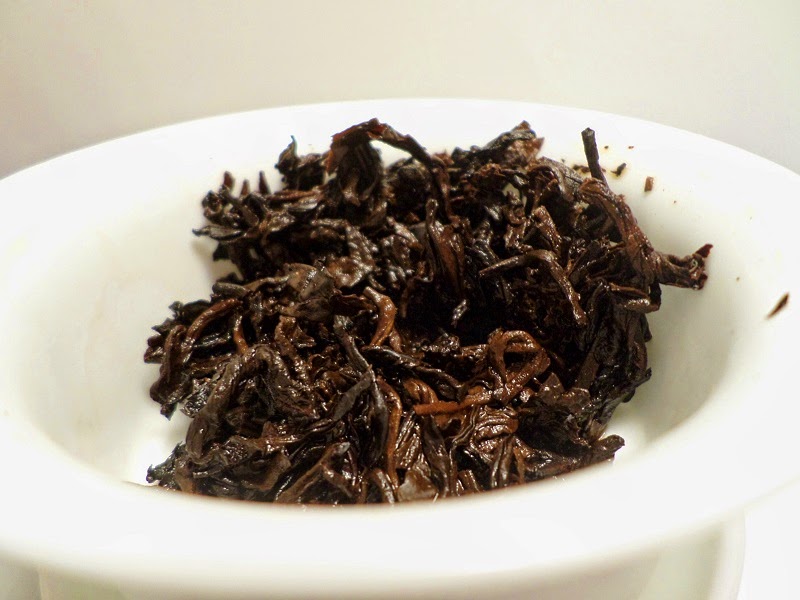
The leaf is as interesting as the aroma. Look at all the color. See picture at top of page. It is green and brown with a plentiful amount of silvery buds.

I used a knife along the outer edge, in towards the center and began to work my way around the edge. I removed about 10g for steeping. Placing it in my clay pot, a few ounces of boiling water was added and poured off after 10 seconds. I then let the leaf sit in the pot and awaken before adding water for the first cup.

Lovely Nectar
The result is an apricot cup with a little sediment because I did not use a proper filter. It doesn't bother me. This is a 2014 pressing. I braced myself expecting a sharp astringent sip. What I got was a tasty cup with only slight astringent notes and as the description says it flows in and out. I caught faint straces of smoke. It is slightly sweet and nicely gentle for such a young sheng. The aftertaste reminds me of peach.

The second cup starts out almost syrupy. It is even sweeter and the peach aftertaste is stronger.

I intend to have many more steeps from this leaf over the course of the day. While I am by no means an expert on Puerh, I know what I like when I taste it. This I like. It is full of flavor without assaulting you with the usual astringent bite.

You can find Jalam Teas Bada Mountain Sheng Puerh here.

Saturday, August 22, 2015

3 Leaf Tea, Aged Tangerine Pu'erh

3 Leaf Tea Description:
2009 pu'erh packed into a tangerine, imported from China.

Steep 1 tsp in boiling water for 3 minutes.

Sample provided by 3 Leaf Tea

My Review:
The wife and I went to town this morning to have breakfast. Met up with a couple old friends and enjoyed some good food and good conversation. When we arrived home and checked the mail, there was the usual pile of bills and an envelope of samples from 3 Leaf Tea. This is a new company launched in 2014. The owner, Luciana, has developed several flavored matcha. She also has hot chocolate, and a small collection of loose leaf teas. In the envelope was one sample of each category (matcha, hot chocolate, and loose tea).

Normally, when I receive samples they go to the back of the box. I do try to mix things up so you don't read only reviews of one company through several posts. 3 Leaf Tea arrived at the most opportune time. I have been craving pu'erh for a few days but haven't been home long enough to enjoy it. Today is finally the day and I have never tried a pu'erh aged in a tangerine before.

The sample arrived in a clear plastic ziplock bag. As you can see the label tells you what you are drinking and how they recommend you prepare it. I appreciate the steeping instructions being on the label - no web searching required.

The dry leaf has a very fresh scent. It is fresh hay with just a touch of fruit from the tangerine. There are no off aromas.

The leaf is loose and dark twists. Pieces of the tangerine are clearly evident. Based on the picture on the website, I assume when you order this, it includes an entire tangerine packed with leaf. I really should check on this and update.

The sample was about 2 tsp of leaf. The directions call for 1 tsp per cup with boiling water. The steep time is 3 minutes. This is not how I normally prepare pu'erh but I am going with the directions and we will see what happens.

The resulting liquor is at first glance 'tea' colored. Actually, it has a slightly more ruby tint than the normal orange/brown cup. The however is that it is not the deep inky black sip I was expecting with a long steep.

The wet leaf is black and has an aroma far more characteristic of shu. It is strongly barnyard in scent. This seldom translates into the cup so don't smell the leaf if you don't want to know.

Upon first sip, I am again surprised. I am not sure exactly what I was expecting. I guess I was thinking this would be a heavily fruit flavored cup. It is not.

The taste is a dusty dry spiciness that is neither astringent nor bitter. It has a deep but gentle earthiness that lets you know it is pu'erh. There is also a background note of tangerine/orange zest.

This first cup isn't particularly sweet on its own so I added sweetener to see what happens. It does not bring out any new flavors but it does make more space for what is present. Just take it easy. It gets very sweet very quickly. At this point I think this would make a great iced tea. I did not attempt it.

The second cup was a nearly four minutes. At first, while the cup was really hot, I thought the dry spiciness had disappeared. Once the cup cooled to a comfortable to me temperature the taste had returned to nearly identical to the first.

This is not a pu'erh of great complexity and depth but at the price, I don't think it is trying to be. What you are getting is an interesting everyday sipper. I think this would be a fun one to play with by adding various homegrown herbs and see if you could com up with an interesting blend. I have some chocolate mint and some lemongrass and one or the other just might find their way into the rest of this sample.

You can find 3 Leaf Tea Aged Tangerine Pu'erh here.

---------------------------------------
Update:
I contacted 3 Leaf Tea and asked about this tea. When you order, you do indeed get an entire tangerine filled with pu'erh. That makes this an even sweeter deal at the current $2.50 price.

Friday, July 3, 2015

Crimson Lotus Tea, 2008 Bulang Imperial Grade Shou / Ripe Puerh

Crimson Lotus Tea Description:
This tea was featured in the Serious Eats article Where to Buy Amazing Tea Online.

This dark puerh comes on strong quickly. It will brew thick and dark at the beginning but then mellow into a light sweetness. The leaves are all small buds and carry the name "Imperial Grade"

The Bulang mountain range is the famous home to some of the best puerh tea gardens in all of Yunnan. These leaves were harvested from trees 100 years old and blended by the Menghai Yunhe Tea Factory from different areas in Bulang at altitudes averaging 1600 meters.

This is one of the shou puerhs that really stood out to me during our 2014 sourcing trip. It's everything I want in a shou puerh. It has a thick mouthfeel, with a hint of astringency, and sweet aftertaste. It's truly delicious. I can and do drink this one every day.

These are generous leaves and can be brewed 15 times or more. Use 5-7 grams of leaves and brew with 8 ounces of water at or near boiling. Rinse twice for 3s each. Start with quick steeps under 10s. With each re-steep adjust the steep time to your taste.

Sample provided by Crimson Lotus Tea

My Review:
When Crimson Lotus Tea offered to send samples of their pu-erh, I informed them that I had been very ill and was not sure how long it would take me to feel up to preparing tea and writing the reviews. They sent them anyway and told me to take my time and get well. So thank you Crimson Lotus Tea for your patience and your kindness.

I used the company product photo above to show what you get if you order a brick. To the right is the sample packaging I received.

This is a resealable black coated aluminum bag with a simple label. The suggested steeping instructions are not on the label but are in the product description on their website.

Opening the bag, I catch the aroma I expect. It is partly hay and part barnyard. With a little experience you learn not to fear that scent as it is a natural part of the process.

Examining the sample reveals a lot of cinnamon brown buds. The company description says this is made with only small buds.

I did not try to pry it apart, so I can't comment on how tightly it is pressed.

I used my press today because it was already out and I am thirsty. The clay pot might have been a more traditional approach. Per the directions I used near boiling water and did two 3 second rinses.

Unless you are a regular follower, you have no idea how hard rinses are for me to actually do. The reason for them is to rinse the leaves of dust and to wake up the leaves. I always end up drinking the rinses (as I did here), so normally I skip this step and just add time to my first steep.

For the first mug I steeped for 10 seconds. Also per the instructions I am using 8 ounces of water for each steep. I am thrilled to see a company recommend a real cup size. I personally do not enjoy over leafed tiny cups of tea. Feel free to disagree.

The result of my effort is a hearty root beer colored brew. If it had a good foamy head on it, this would almost pass for a stout ale, except for the pink tinting. It is kind of pretty.

The leaf chunk is still fairly intact and solid in the middle. The edges show some definite signs of breaking up. The leaf is shiny black.

The wet leaf aroma is much like the dry scent but stronger. Don't be alarmed as the taste seldom resembles the leaf scent.

In fact, it bears little resemblance to the aroma. Up front this has a mild bite. What is fascinating is the feel is thick and creamy along with the bite. Two different sensations layered over each other and it works. After the bite settles in, this drifts into a taste that reminds one of horse tack (leather). Finally it melts into a smooth sweet finish.

The leaf is capable of lasting through 15 steeps according to Crimson Lotus Tea. I am not going to be able to confirm that here (though I have little doubt), but I am going to have time for one more cup before posting.

Cup two was not timed. I poured the water into the press, replaced the lid, and nearly immediately began pouring into the cup. The brew is much darker. It looks ruby red as it pours. Though darker in the cup.

This cup continues on where the first left off. The big differences are the addition of a cedar note up front changing to the leather, and the bite coming late in the sip. Oh, just caught a hint of smoke when I exhaled. Neat.

This is a really nice shou. It is complex enough to be interesting, but not so complex as to demand deep concentration. This would make an excellent everyday drinker.

You can find Crimson Lotus Tea, 2008 Bulang Imperial Grade Shou / Ripe Puerh here.

Monday, June 22, 2015

Wymm Tea, Jingmai Sheng Pu-erh

Wymm Tea Description:
This is a sheng pu-erh that brews bright golden liquor with a heady orchid aroma, and can last for around 15 steeps. First spring leaves make the best-valued tea because of the concentrated nutrients, and the infused liquid emanates strongest aroma and flavour. Picked from the first spring of 2011, our Jingmai pu-erh possesses opulent aroma and intense flavour that is reminiscence of wilderness of Jingmai.

Sample provided by Wymm Tea

My Review:
Today's selection is a raw pu-erh picked from ancient trees in 2011. The trees are very old. The tea is fairly young. Sheng, at least youg sheng, has a tendency to have a sharp bite. Let's see what this one brings.

The leaf itself is gorgeous. At least to my eyes. When I unwrapped the paper, exposing the loose leaf (sample is loose, a bing is available), I was immediately impressed with how fresh it looked. I know it is dried and brown, but it looks so alive. The silvery buds along with the tans and lighter shades have kind of a green cast to them.

I really did not detect an aroma off the dry leaf.

The entire sample (6 grams) was added to the pot and boiling water added. I don't bother with rinses. The first steep was at 10 seconds. I am preparing this in small amounts in my press to fill my gaiwan for drinking. Why didn't I just use the gaiwan to start with? I have no idea.

Now I catch an aroma off the leaf. It is floral and leafy. It has some of the young sheng aquarium water scent - not fishy, but like a living watery habitat.

The liquor is clear and a nice honey color.

Bracing myself for the taste, I quickly relax. Ooh, this is nice. I was expecting a bright metallic bite. Not even close. The first thing I notice is a light hint of a smoky edge. Then the flavor springs out like, well, spring. It is a really lovely floral. It is not alarmingly so. I detect no rough edges, or off flavors. It feels thick on the tongue. It leans slightly towards sweet. The second cup is pretty much the same. I am noticing very little astringency which is unusual for the shengs I have tried.

Cup 3, 4, & 5 introduce a shot of pepperiness. The smoke note is now moved to the aftertaste and remains very light. The flavor is now more vegetal and floral and the astringency has picked up a tiny amount but remains far more controlled than I am use to tasting in sheng. An apricot note is also present in the sip. The aftertaste is floral.

As usual for me, I prefer the development of the flavors as the cup cools.

Wymm Tea says this will go 15 steeps. I'll not be able to find out today.

Bottom line: I found this to be a very pleasant and easy to drink sheng.  

You can find Wymm Tea Jingmai Sheng here.


Wednesday, June 17, 2015

Wymm Tea, Menghai Wangshuji Shou Pu-erh in Seventh Grade 2008

Wymm Tea Description:
This shou pu-erh brews with a rich and honey flavor and long-lasting jasmine rice aroma. Full tea leaves from high mountains in Menghai County, located in west of Xishuangbanna Dai Autonomous Prefecture in Yunnan Province, are picked to make the tea in 2008. Pu-erh tea has the potential to ferment over time, and this tea has been post-fermented for 6 years since production. Post-fermentation gives the tea vibrant flavours and richer aroma as well as deep wine colour.

Note: First grade contains the smallest leaves while seventh grade contains the largest leaves. There is marginal difference in the taste; first grade has a slightly stronger and woodier flavour, while the seventh grade has a milder and sweeter flavour. The third and fifth grades fall in between of the first and seventh grade.

Sample provided by Wymm Tea

My Review:
Woke up this morning and decided it was shou time!

This sample from Wymm Tea came wrapped and tucked inside a proper paper wrapping, allowing the leaf to breathe. With most tea leaf, air is a bad thing. With pu-erh it helps with the aging process.

The leaf is loose and of large size. It is mostly dark and resembles tree bark. In the picture I notice some twigs. There is not a lot of scent. It is mildly barn, with hay and some composting scent, along with a touch of leather.

I used boiling water and about a 10 second steep for the first cup. I prepared this for western mug because I just didn't feel like a bunch of tiny steeps - as I would just pour them together anyway.

As you can see from the picture the first cup is light. Here it looks orangish. In reality, it was the same color as my Sue Bee Honey which is just out of camera range.

The steeped leaf is nearly black and has that shiny neoprene look. The leaf has a strong barnyard aroma.

The sip is immediately likable. I am getting zero rough edges prepared my way. There are no off flavors.

This is very smooth. It is also quite creamy. The flavor note is mainly earthy forest wood. There is a bit of dryness on my lips, which I find interesting since this is so creamy. It is mildly sweet with just a touch of honey flavor.

The second mug was also steeped at about 10 seconds. It is darker than the first and still lighter than expected. The flavors while hot are very similar to the first with more of a spicy note with a unidentified fruity note - maybe it's cherry. Once the cup cools the spiciness fades. I did not get to taste the first mug while really hot, as I was distracted, so this note might also exist in the first.

I believe there are many steeps left in the leaf. I'll stop the review here but continue on tasting later today.

Conclusion: This Mehghai from Wymm is an easy sipper, worthy of trying.

You can find Wymm Tea, Menghai Wangshuji Shou Pu-erh in Seventh Grade 2008 here.

Thursday, April 30, 2015

Wymm Tea, Mahei Sheng Spring 2011

Wymm Tea Description:
This is a sheng pu-erh that brews bright yellow liquor with a delicate taste and silky texture. The tea is full-bodied with minimal astringency, and brings back a prolonged honey-like aftertaste.

Sample provided by Wymm Tea

My Review:
I received 4 samples from Wymm Tea some time back and before I could review them all I became pretty seriously ill. Having only made it through one so far, I am feeling up to the task today. Bring on the poo!

This is a big leaf ancient tree tea. It is sold in a cake. The sample is probably taken from a cake as it shows some signs of having been compressed, although at first glance it resembles a loose leaf. The sample came wrapped in handmade mulberry paper.

The leaf is gorgeous with lots of golden buds. I even see some streaks of silver. The leaf has a nice fresh scent. It is far more field than farmyard, with just a hint of leather.

The website info on infusions says to use 212 F (100 C) water and 7 grams of leaf per cup. The sample appears to be between 6-8 grams so I tossed it all into my clay pot.

I already know. if I do a rinse, I'll just drink it, so why bother pretending? My first steep time is about 20 seconds. Enough time to walk away from the pot and turn off an alarm on my annoying phone.

The wet leaf is pea green and prettier than my picture suggests. The brew pours an apricot color. I steeped longer than I intended, as it is not the yellow in the description. That makes me a little nervous as this is sheng. Sheng, especially young sheng, tends to be very astringent. What have I done? What have I done?

Actually, nothing bad. The leaf is fresh in scent, having a light leather and asparagus scent with seaweed undertones. I also catch something along the lines of mint or menthol.

The taste has a light bit of smoke. This is the first time I can recall catching a smoke note in the taste even though others record it often. There is a light amount of mineral that morphs later into a fuller bodied bite with a touch of leather. This is followed by only a slight astringency. I am not really getting the usual camphor at this point but there is something mildly cooling in the taste.

I came as close to a flash steep as possible for me on the second cup. Poured the water. Replaced the lid, Poured into the cup. Maybe 5-6 seconds? The cup is just as dark as the first.

The taste has moved some. Now I get a spicy cedar/cinnamon mixed with leather. There is a light metallic brightness behind the leather. The combination is an interesting cooling heat. The aftertaste is sweet. Maybe not honey, but sweet.

What impresses me with these cups is the total lack of throat grabbing bitterness. Instead what I am getting here is a really nice tea buzz also know as qi. Really, it hit me suddenly as I began this paragraph. I would love to indulge it more, unfortunately, with the medication I am taking, I have to watch my caffeine intake. So I have to bid this one farewell today. The leaves will still be here in the morning and ready to go more rounds. This is a good one.

You can find Wymm Tea Mahei Sheng Spring 2011 here

Monday, April 13, 2015

Wymm Tea, Menghai Wangshuji shou pu-erh in third grade 2008

Wymm Tea Description:
This shou pu-erh brews with a rich and honey flavor and long-lasting jasmine rice aroma. Small buds from high mountains in Menghai County, located in west of Xishuangbanna Dai Autonomous Prefecture in Yunnan Province, are picked to make the tea in 2008. Pu-erh tea has the potential to ferment over time, and this tea has been post-fermented for 6 years since production. Post-fermentation gives the tea vibrant flavours and richer aroma as well as deep wine colour.

Sample provided by Wymm Tea

My Review:
First, thank you Wymm Tea for the samples and the patience while I am recovering from a recent illness.

I received this in a padded envelope containing a hand written note and a brown paper wrapper tied with twine. A neat logo that I think is pressed into leather was attached to the string. The packaging looks awesome. Inside were four samples from Wymm Tea. Each is wrapped in rice paper. According to their website it is handmade. The paper is folded around the sample and tucked under securely. A small printed sticker on the outside identifies the sample.

Inside the rice paper is the chocolate colored leaf. This has not been compressed and is made of large lightly twisted leaf. The leaf scent is much to my liking. Wymm calls it a long lasting jasmine rice aroma. Having never smelled jasmine rice, I find it to be more of a boot leather scent, but I really like that smell.

I used the whole sample in my brown clay teapot. I won't call it Yixing anymore because at the price I paid there is no way, however I like it and it works well. Wymm recommends 3 rinses with boiling water, each at 10 seconds. The first I used maybe 3 ounces of water. The tea was red wine in color, so I drank it. Yeah, I just can't do rinses.  

I let the leaf soak up what moisture remained in the pot for several minutes and did another 'rinse'... that I drank. If it tasted bad after the first sip, I might pour it out, but really it was very tasty and full.

So admitting I am not going to follow instructions, I brew my first real cup. Wymm suggests 7 g of leaf to 250 ml (abt 8 ounces) of water. I am using about 6 ounces for each cup. The steep was supposed to be around 5 seconds but ended up more like 10. The cup is dark, resembling coffee. It is not inky black, just dark chocolate in color. The steeped leaf is almost black and has that wet vinyl shiny look that always reminds me of the monster in Alien. I may not be wired right but I am seldom bored.

The taste is much like the rinses. Instead of boot leather like the dry scent, this is old family Bible leather. There is a gentle sweetness to it. I find it immediately warming and comforting. There is no bitterness and nothing off about it. This is nicely smooth with no rough edges. There is a woodsy cedar spiciness late in the sip that adds just enough bite to be interesting without adding distraction.

Man, it has been a while since I have had shou pu-erh. My tummy is thanking me with sounds of appreciation.

For the next cup, I poured the boiling water into the pot, placed the lid, and immediately started pouring. The result was still nearly a coffee colored cup. It looks like wine as it pours. I just can't pour fast enough. The taste remains as in the previous.

I feel comfortable saying this will steep many more time throughout the rest of the day. I hope to get the opportunity to find out. This is a very lovely shou.

You can find Wymm Tea, Menghai Wangshuji shou pu-erh in third grade 2008 here.

Tuesday, February 10, 2015

Jalam Teas, Manmai

Jalam Teas Description:
Manmai fermented (green) Puerh is a return to one of our most coveted regions, Bada Mountain, and a true ‘high mountain tea’. Manmai village is located in the Bada Mountain range and has fantastic conditions for producing superb teas. High humidity levels, mists that filter sun and rain and an almost wild aspect to the geography make this a “zone of perfect tea possibilities”

Sample provided by Jalam Teas

My Review:
Jalam Teas contacted me to see if I would like to review one of their puerh teas for The Everyday Tea Blog. I have a mountain of samples I have not yet reviewed, but I haven't tried anything from Jalam Teas previously, so saying no was not an option. I really didn't know what to expect in the way of a sample size. The package arrived containing a full 100g cake. Excellent!

Included in the package is a large card with a lot of information about the tea, where it came from, and when. This one is a fermented puerh from the spring 2013 harvest on the Bada Mountain range.

The cake is wrapped in paper.  Removing the wrapper reveals this tightly compressed cake of lovely Yunnan leaf that appears to contain a lot of golden tips.

I used a pocket knife to pry off about 8g of leaf for this session. It was easy to embed the knife, yet harder to break off a solid chunk. The leaf has a slight barnyard scent and something else that I can't quite identify. It was sweet and I'm thinking it was caramel.

I used boiling water per the website, "Use fully boiled water, as the large leaf 'Camellia Sinensis Assamica' (Puerh) can handle the heat." I also used my 90ml gaiwan again today. I am still a klutz but getting more confident. I didn't make a mess and did not burn any fingers. I consider this a solid victory.

I don't do a rinse to awaken the tea. I'm stubborn that way. Instead I increase the first steep. My first steep was about 15 seconds. The liquor was orange red tinted as it poured into the cup. It appears almost coffee colored in the cup. The aroma is much like the dry scent.


The tea is very smooth. The rough edge that I often associate with ripe puerh, that is kind of like sandpaper, is pretty much non-existent. There is none of the astringent bite or harsh metallic taste that is found in a young raw puerh. There is no bitterness. Again, the best descriptor is smooth.

The taste is cedar but not scratchy feeling. It also has a flavor like leather. I use that description often as it is a flavor I like. The however here is, this is not the horse tack leather, or dusty old book leather, I often cite. It is not even a less mentioned boot leather. The flavor is a new one and reminds me of oiled belt leather. I am also tasting just a bit of barnyard, but it fits and is not offensive to the senses, even though it may sound that way. 

For cups two and three, I did flash steeps. The water was added to the gaiwan, the lid put in place, and as soon as I got a firm grip, I began to pour into my cup. This produced an equally dark, as the first, cup and a very similar taste.

Cups four, five, and six, are still flash steeps, however I combined them into one cup for drinking. The flavor remains rock solid to the earlier cups. I am now thinking it is becoming more milk like in texture.

Cups seven, eight, and nine, I increased the steep by about 5 seconds on each, then combined them. If anything, the color is even darker. I have no idea how much longer this will steep, but it is showing no sign of letting up. This will be my last for today.

The tea continues to be a pleasure to drink. While the texture continues to become thicker, the flavor remains true to the first cup.

Jalam Teas says this would make a good evening tea as it is light on the stimulant kick. I think they have a higher stimulant kick tolerance than I. To me this would make a much better morning tea. It is easy to drink and easy on the stomach.

For those who might be interested, Jalam Teas has a monthly tea club.  Per the website, "Each month you'll receive a specially designed 100-gram tea cake complete with an intimate story of each and instructions on how best to prepare your monthly dose of green."

You can find Jalam Teas, Manmai puerh here.

Saturday, February 7, 2015

Teavivre, Menghai Palace Ripened Pu-erh Cake Tea 2008

Teavivre Description:
Tribute grade pu-erh: abundant golden pekoe covering on the buds, nicely crafted. The taste is smooth and thick, carries strong nut’s fragrance. If you love ripened pu-erh, choose this golden cake.

Sample provided by Teavivre

My Review:
It's shu time! This large leaf ripened pu-erh comes from 90-120 year old trees found on Bulang Mountain in Menghai, Xishuangbanna, Yunnan, China.

This was a sample portion that came in the usual silver bag. Removing the leaf reveals a lot of golden tips throughout the compressed cake. The aroma is a light barnyard and nicely sweet with some dried grassiness.

I used the 90 ml gaiwan today and the entire sample (approx 10g). The water was kettle heated to boiling.

The first steep was about 12 seconds. As I have mentioned before, I seldom rinse the leaf, instead I increase the first steep slightly.

The result is a orange brown cup. The shape of the cup distorts the evenness of the color. The aroma is still somewhat barnyard. The taste is dusty but sweet. It has no rough edge or off tastes. It is actually quite smooth. It is a little earthy and like damp forest woods. Very nice.

I noticed a cooling sensation in my lungs and it seemed to allow for deeper cleaner breathing.

The second cup was steeped at 6 seconds. It is much darker. It is more coffee colored but with a red tint that the camera isn't showing.

This cup is a little more rough edged but not unmanageable. It has more of a cedar briskness. I didn't notice the aroma, so the barnyard must be fading. It just hints at leather.

The third cup I began pouring as soon as I could get the lid on the gaiwan and a proper grip. This is even a deeper burgundy. The aroma is spicy cedar and light mint. This is dry like a red wine. It has a spicy cedar wood flavor. I also catch more of an earthy loam note along with hints of leather. This is the best cup so far.

Cups four, five, and six, were all prepared just like the third with little more steep time than it took to fill and pour. I combined them. The brew seems to be growing even a deeper burgundy in color. It shows no signs of letting up, but this will be my last cup for this review.

Much to my delight, the taste continues in the same vein as the previous cup. This retains the dry cedar briskness, followed by a rich loamy earth. The leather continues to stay out of the limelight but hints at an old book leather.

With this cup I am noticing the faint touch of inner cheek tingle.

Possibly my favorite thing about this pu-erh has been the calmness that fills me as I sip it. I believe I am more mellow than the tea I'm sipping. Yep, feeling pretty groovy. I think I'll turn on my lava lamp (I really do have one), and crank up some Pink Floyd. This isn't magic psychedelic stuff, but it is pretty far out man ;)

You can find Teavivre, Menghai Palace Ripened Pu-erh Cake Tea 2008 here.

Wednesday, February 4, 2015

Teavivre, Rice Ripened Loose Pu-erh Pyramid Tea Bag

Teavivre Description:
This tea bag features its flavor which has slight glutinous rice flavor. It is a good routine beverage incorporated with the essence of “Nuo Xiang” plants grown in Xishuangbanna. The liquid is bright red brown in color and have a typical flavor of Pu-erh.

My Review:
I don't recall how I acquired this one. I think it came from a friend rather than from Teavivre directly. Not that it matters. I just like to be up front about it.

Today's tea is a bagged pu-erh. Actually it is a pyramid bag made of corn fiber.

If you search this blog, you will learn I am not opposed to the use of the lowly tea bag. The old reliable paper ones have their place. This is especially true when I am in a hurry, asleep, or just want a simple tea with my meal.

The average grocery store tea bag will never give you the depth that a quality loose leaf will, and that is why the pyramid bag has risen in the market place. The pyramid bag generally contains a better quality leaf while retaining the convenience factor of the bag.

You can see the Yunnan large leaf through the bag. There is an abundance of golden buds in the mix of one bud and two leaves. The aroma is... different. Reading other reviews this apparently is a very accurate sticky rice scent. Being uninitiated, it comes off as more gym bag to me. Honestly, I am glad to know the aroma is exactly as intended. Even if this red neck doesn't quite get it.

I used a mug and boiling water. The directions call for a 9-12 minute steep. Seriously? I get that Teavivre is attempting to make pu-erh a little more accessible to the western tea drinker with the use of the pyramid and the steep time. I get it, but I don't prepare pu-erh that way anymore.

I went with three minutes which still produced a dark coffee colored brew. I would normally do maybe a 30 second first steep, so as far as I am concerned, I have made a major compromise.

The sticky rice aroma has now filled the house. I am noticing the longer I am inhaling it, the more food like (and therefore appealing) it has become.

Interesting. It's rice, rice, and more rice, all the way to your lips. Then once you taste, it becomes a gentle earthy pu-erh. It is not leather, mushroom, or any of the barnyard flavors and definitely not a more offensive fishy flavor. This is a dusty roots and rich soil flavor. Just a touch of mineral. It is very smooth and easy to sip.

After swallowing the sweet sticky rice aroma comes back and mixes with the earthiness. It is a neatly interesting combination.

I do see where the long steep time recommended by Teavivre would not hurt this cup. A long steep can produce a rough spicy edge that I often don't much like. I do not see that happening here.

I do have one complaint. The string on the pyramid is too short. The tag was sucked under the moment I added water. I had to fish it out. That detracted from the convenience of using the pyramid for me. Next time I'll know better and keep a thumb on the tag when adding water.

These little pyramids will resteep multiple times making them a good value consideration.

You can find Teavivre, Rice Ripened Loose Pu-erh Pyramid Tea Bag here.

Thursday, January 22, 2015

Mandala, Temple Stairs 2014 Ripe Pu'er Mini Tuocha

Mandala Description:
We are pleased to present yet another Mandala Tea exclusive ripe pu’er. This creamy and smooth two leaf blend was created using grade one material that was spring-picked and ripened in 2012 and 2013.  Not only were both pickings from plantations that are pesticide free, but the two growing areas (at Bada and Mengsong) are far from any cities or air pollution. This is 100% pure tea and some of the finest ripe tea available.  We also note that the leaf was expertly cared for in the process of fermentation, yielding a perfectly ripened leaf with full integrity.  Teas from these areas are famous for their uplifting nature as well as their qi raising goodness. As this tea warms your lower dan tien (in laymen terms - the “energy bank account”), you will note hints of cocoa in aroma and taste. Flavors of sweet root vegetables with hints of dark brown sugar dance on your tongue alongside the clean and well-rounded essence of minerals.

My Review:
Another acquired from a Steepster tea friend, who I owe some tea, even if she doesn't need it. This is a personal sized toucha. I generally love these things. They are almost as convenient as a tea bag. but far better quality when you get them from a reputable dealer.

This is a ripe pu-erh and each toucha weighs in at about 5.1g. Unwrapped it is a typical nest shape of dark browns with lighter cinnamon colored leaf. It has a typical toucha scent- that means hints of barnyard and earthy but not offensive.

I used a 90ml (3oz) gaiwan today with boiling water. The first steep was 20 seconds. I don't do rinses.

The first cup is a dark orange. It has an aroma similar to the dry leaf. The toucha has swollen but remains almost entirely intact.

The sip is very smooth. There is no sign of the rough edge that often accompanies ripe toucha. this cup has a slight earthiness. It reminds me of the smell while digging up potatoes in the dry soil. I also get a sense of leather but only mildly. It finishes with a wonderful mineral sense. For a first cup this is really nice.

With second cup I poured boiling water into the gaiwan and immediately put on the lid and began to pour. It takes a few seconds to pour from the kettle and the gaiwan - so lets call it 10s. I was shooting for 5.

The brew is as dark brown as coffee. The toucha has pretty much disintegrated. This has a bit rougher edge. It seems more bitter, but not horribly so. I am still not getting the brown sugar or cocoa Mandala mentions. What I am getting is similar to the first cup. Not sure why, but this reminds me of coffee even though it tastes nothing like coffee.

Third cup prepared similar to the last but my pouring was a little quicker. This is still very dark and has more of a burgundy cast to it. The edge is lighter in this cup and as it subsides. drifts into the pleasant leather tone hiding beneath. This has a pleasant calming effect.

Fourth cup, it occurred to me I was not reviewing this tea on an even playing field. Normally I use a big clay teapot and prepare 8 oz at a time. So, to rectify this I prepared this cup, at 10 seconds, in the gaiwan and poured into my mug, then added enough water from the kettle to make an 8 oz serving. The color is a deep burgundy tinted orange.

The rough edge has been taken off the cup. Now I am back to smooth leather along with earth and sweet hay. It again finishes with a nice rounded mineral taste.

OK, this proves to me I much prefer a Western mug method when preparing touchas. It is also a reminder to you to always be willing to experiment with alternate parameters when you think something can be improved upon - or maybe more so when you are pretty sure it can't. The results might surprise you.

This is a good ripe toucha. It will go more steeps, but this is where I am stopping today.

You can find Mandala Temple Stairs here.


Wednesday, January 14, 2015

Lao Cang, Honeysuckle Flower Ripe Puer Bowl

Lao Cang Description:
These premium mini tuo cha are made from Simao fermented ripe pu-erh. These are about 4-5 grams each. The brewed liquor is a lovely deep red color and the flavor is rich, sweet and smooth. This is a great drink for a dry throat , after a heavy meal, or just for enjoyment alone! In traditional Chinese medicine, honeysuckle is considered one of the most important herbs for releasing poisons from the body and clearing heat from the body.
They are small tea cakes of ripeYunnan large leaf as raw materials Mixed with the Honeysuckle Flower, by fixing, rolling, dry daylight, autoclave refining process and compressed into the bowl shaped cake which you can easily drop into a cup or teapot for a quick and easy brewing of your Pu-erh tea time. Each tea cake is individually wrapped for convenient storage that will make the Pu-erh tea last much longer and easy to carry.

My Review:
This one came my way from a friend, who got it from a friend, who... I have no idea where it was purchased. After some digging I located one source but there are probably many. I found it on Aliexpress from Royal Tea Bay. The store has a pretty high rating but I can't vouch for them or Aliexpress.

So under the bright yellow wrapper this appears to be a standard bird nest shape made of tightly compacted leaf. I don't see a lot that says honeysuckle in the dry mix.

I used my clay teapot and 3oz of water heated to boiling. I did not do a leaf rinse. The first steep was at 20s. The result is a gray tinted orange brew. The toucha has plumped but has not really even started to disintegrate. The leaf and cup have a light barnyard scent that might frighten a first time sipper. Trust me, I've drank many that smelled a whole lot worse and they tasted fine.

First Cup Is Very Light
The first cup is light in taste. It is kind of stone like in taste. There is no bitterness and very little if any astringency. I am getting a feeling of heat but it is not a spicy heat. Another flavor comes in towards the end that I can't identify yet, but mixing with the aroma, I am picturing horses. The cup only hints at what is to come.

The second 3oz cup at 12s is a lot darker. It is not quite coffee color but getting close. The toucha is halfway dissolved and has a much stronger barnyard aroma. The cup has a lighter barnyard aroma mixed with cedar. Now the flavor has really picked up. This is a mix of horse tack (leather) and cedar, with a spicy bite late in the sip. I also notice some floral notes, though I admit to not thinking honeysuckle. There is a bit of pucker power to this cup.

Cups three and four were combined to make a 6oz cup. My kettle takes a few seconds to pour and the clay pot pours steady but also takes a few seconds. I wanted about a 6s steep, so after adding water I waited just a couple seconds and began my pour. The brew is coffee in darkness.

The toucha has completely dissolved. I do see the honeysuckle petals in the mix. I am also impressed by the leaf used in this inexpensive pu-erh.

This cup is dusty horse tack with a smooth spicy finish. The best cup so far. The spice and the pucker factor have tamed way down. I am enjoying this one quite a lot. From past experience with flowers added to the mix, I don't notice the honeysuckle so much as credit it with bringing the smoothness to the cup.

This shows no signs of letting up. I will continue to steep for a while.

Concluding thoughts - I have had far more complex pu-erh, but for an everyday convenient and affordable version, it is hard to beat touchas. This happens to be a nice example. The downside is the aroma might scare you off. The upside is this smooths out into an enjoyable cup.    

Wednesday, January 7, 2015

Teavivre, Ripened Chrysanthemum Pu-erh Mini Tuocha

Teavivre Description:
Infused with a beautiful tiny Chrysanthemum flower in each tea cake, these Mini Pu-erh Tuocha (or tea cakes) are created with our premium ripened Yunnan Pu-erh tea, harvested in 2008.  The warm mellow and earthy flavored Pu-erh tea flakes are compressed into a beautiful bird's nest shape then individually wrapped for proper storage.  The light Chrysanthemum lends a light and aromatic floral tone to the more earthy flavor of the Pu-erh, and the tea cakes are a convenient way to brew your tea by dropping one tea cake into your cup or teapot.  When brewed, the Chrysanthemum flower is revealed, and the tea is infused with its flavor and aroma.

My Review:
It has been too long since I have reviewed a puerh. It has been even longer since I have reviewed a ripe one. Today's tea is from Teavivre.  I got it through a botched trade with a Steepster friend. I sent her the wrong tea. I realized it the day after putting it in the mail. She was more than gracious and sent this along with several surprises to be reviewed later.

So, toucha are just cool. Single serving size. No Fuss. No measuring. They are wrapped in thin paper as pu-erh needs to breathe. Removing the paper reveals a little nest made of dark post fermented leaf and chrysanthemum petals. I detect no real aroma from the dry toucha.

I decided to use my 90 ml gaiwan for today's session. Why? Because I can. Filtered water was heated to 100C (212F) and poured around the edges of the gaiwan. The lid put in place, I steeped for 12s. I did not do the recommended rinse first. The liquor is wine like burgundy as it pours, turning more of an orange/brown as it cools.

The wet toucha has only partially disintegrated. The aroma is like that of battered and deep fried fish and fries. I have not seen that description used anywhere in connection with this pu-erh (or any other), but I can only offer what I experience. It is a strange scent, that made me hungry.

The taste of the first cup is really very similar to the aroma. It is like fish and chips meets hazel nut. Very unusual yet somehow I like it. Again, I did not rinse the leaf.

The second cup at 10s is a completely different tea. The moment the water hit the leaf, it turned very dark, like silky dark chocolate. The aroma is a bit barnyard. That normally doesn't concern me, as it is seldom an indicator of the taste.

This time the aroma does match the taste. In addition, it is bitter, with a strong spiciness. I also detect cedar and some sense of old leather. About now I questioning if I should have used a western mug method instead of the gaiwan.

Third cup was steeped for 5s. The tea pours a beautiful red wine color. There is no off odor in this cup. It is rich, earthy, and cedar. Once again the taste coincides with the scent. The spice note seems more connected to the cedar in this cup and the leather is less noticeable. This cup is not bitter.

One thing is for sure, this tea is a roller coaster ride - frightening one moment, exhilarating the next. Holding my hands up high and preparing to scream real loud with a smile on my face, it's time for round four.

Steeped at 10s, this is the best cup yet. There is no bitterness or barnyard. This is rich spicy cedar, and much smoother than the previous cup. The leather is more prominent this time.

Can we ride the coaster again? Can we? Huh? Can we? Yes please!

Cup five @ abt 12s. The tea continues to pour burgundy but looks much darker in the cup. This is almost a mirror of the previous cup. The spicy cedar and the leather are now more equal. The leather revealing itself to be more of an old book leather. Another excellent cup.

My kidneys are now taking the role of mom and saying, "That's enough, let's go." Meanwhile my taste buds are the gang of friends I'm hanging out with. They are all like, "Pretend you didn't hear her and ride one more time." What to do? What to do? Yep, one more time! I'm a bad boy. I'll be grounded later, but it will be worth it.

Cup six @ abt 15s. The tea is slightly lighter in color. The cedar is now less intense and the spiciness now clings to the old book leather. Very nice.

Mom now has a firm hold on my arm and says I'm done. I'm trying not to cry in front of my friends. I do manage to mudder under my breath, "I never get to have any fun!" ;) Until next time.

 You can find Teavivre Ripened Chrysanthemum Pu-erh Mini Tuocha here.

Wednesday, October 29, 2014

Tuocha Tea, 2008 Menghai 8582 Dayi Raw Pu-erh Cake

Web Photo - not taken from this cake 
Toucha Tea Description:
A classic Menghai tea factory recipe that was first introduced in 1985 for direct sales to Hong Kong Nian Tian company. 8582 Raw Pu-erh Cake use larger mature leaves inside for this cake, the tea has a very refreshingly sweet and smooth aftertaste, gives rich taste and swallows extremely well. Great potential after a few years of aging.

Size & Price:
2008 Menghai *8582* Dayi Raw Pu-erh Cake - 357g, $17.60 (USD)

My Review:
I have had this sample in my pu-erh drawer since spring. I have been so busy it just wasn't fitting in my schedule. Pu-erh waits patiently and instead of losing its appeal, it generally gets better with age. Today is a slow rainy day and it is begging for a sheng.

The leaf on this is mostly loose in the plastic baggie. Originally purchased by a tea friend and sent to me, I believe this was compressed in cake form, as I can find no loose version of this blend for sale.

The leaf is dark but still shows hints of green and I see some whole leaf in the mix. I did not detect any significant aroma to the dry leaf.

I used my Yixing pot and 10 oz of water heated to 212F (100C). I really don't know if I should be using cooler water for a raw tea. I should experiment a little and see what happens. Anyway, I let this steep for about 45 seconds.

A word about my pot - it is big for a Yixing. I know that goes against most people's reasoning for using a clay pot but you know what? That's the way I like to drink my tea. If I use a gaiwan, for instance, I will almost always pour three cups together, so I figure why not just steep it all at once. I use a Yixing simply for the joy it gives me to do so.

The brew starts pouring as a light yellow orange. As it cools it becomes more golden orange. When I poured, I did use a strainer but it turned out to not be necessary. The strainer holes in the pot proved to be sufficient to prevent leaf from escaping.

I have to admit, the wet leaf scent was not very appealing. It kind of smells like a wet carpet. Never encountered that before. The leaf did however turn green and fresh looking. Some of the leaf is whole and appears like it was just picked off the tree.

Tasting the first cup, I am noticing bitterness first, then some astringency in the form of drying. It does seem a little sweet with some woodsy notes trying to come through. Maybe cooler water and definitely a shorter steep is in order. On the other hand, I did not pour off the first cup as a wash. I almost never do, so I'll take the blame for this one.

As the cup cools and I taste while typing, I caught a faint hint of smoke. Promising.

For my second 10 oz pot, I used 200F water and a 10 second steep. The color is only slightly lighter in color. The wet leaf now has a pleasant woodsy mushroom with a hint of smoke aroma. Yeah, that's more like it!

The bitterness is all but gone. Just enough remains to make this interesting. The dryness is also greatly reduced. This is sweet. It feels a bit syrupy. The taste is a combination of stone and mushroom. There is nothing off-putting in the taste. A very enjoyable cup.

Mug three - cup 9, if you gongfu brew - at 20 seconds, is the best yet. A slight bitterness is present. The flavor is again woodsy mushroom with a stone element. The stone is a mineral taste like drinking water poured over rocks. The smoke is light but present late as I exhale.The aftertaste lingers.

This shows no signs of giving up but I want to post the review, so I am quitting here for now.

You can find the 2008 Menghai 8582 Dayi Raw Pu-erh Cake here


Monday, October 20, 2014

Teavivre, Jasmine Raw Pu-erh Mini Tuocha

Teavivre Description:
TeaVivre introduces you this carefully selected Raw Pu-erh Mini Tuocha. It is from one of the four famous tea producing area of Yunnan, Lincang, made of Yunnan large leaf species, are covered with large quantity of soft golden pekoe.

Harvest Time: 2014
Production Date: 2014

My Review:
This was purchased earlier this year during a sale. I've been trying to work it in to my review schedule for awhile now. This weekend I attended a wedding where smoked pulled pork was served at the reception. I had way too much of it. A little self restraint would have been nice but it is a little late for that. I am hoping a session of raw pu-erh will help.

I have always liked mini touchas. They are the perfect size for mug, gaiwan, or yixing brewing. This one looks dense and slightly shiny up close. Some of the leaf crumbled into dust as I unwrapped. The aroma is fresh field with lovely light jasmine flowers.

I preheated my large yixing pot and added 5 oz of boiling water. Teavivre says to steep this between 3 and 5 minutes with 100 C (212 F) water. With yixing I usually go 30-45 seconds on the first steep. I decided to compromise and go one minute.

As you can see the toucha turned fresh and green. It plumped up nicely but has barely begun to relax.

The brew is a light caramel color. It is orange on Teavivre's website. I did not use a strainer so there is some small amount of debris in the cup. There is not a lot of aroma from the cup. I probably should have listened on the steeping time.

I am not getting a lot of flavor. It has a sticky lip feel. It has a slight stone taste, like sipping water flowing over rocks. I do get a very light floral at the front of the sip.

I know this will do better. For the second cup I am increasing the steep time to two minutes.

Now the brew is a hearty orange color. With this being a raw pu-erh, I would not have considered it turning this dark. The cup has a light jasmine aroma. The toucha in the pot has completely fallen apart covering the bottom in a blanket of leaf pieces. I even see a few jasmine petals.

Wow, two minutes has brought out a lot of young raw pu-erh bite. I decided to calm it with a little sweetener. That really helped. This is almost syrupy feeling. The taste is nutty, and vegetal, with a nice light jasmine floral that is more scent than taste. I am also getting a throat warming sensation. It is not the heat of the liquid and it is not a spiciness. I really don't know how to better describe it. It just is. The aftertaste is kind of tingly and almost like a mild tiequanyin. The initial bitterness aside, this is a really neat cup.

Immediately, I heated more water for round three, also at two minutes. The brew is again deep orange. The wet leaf has taken on a fresh pond water and jasmine aroma. The cup scent is jasmine. The taste is very similar to cup two. I once again added sweetener. I notice a dryness and cheek tingle with this cup. This is way better than I am making it sound.

After my session with this toucha, I read a review by Stephanie on Steepster. She did not encounter the bitterness and found this to be sweet on its own. The big difference is she used cooler water at 180 F. My next time out I will do the same. This is too good not to keep working on the parameters to get it right.

You can find Jasmine Raw Pu-erh Mini Toucha here.