Tuesday, January 6, 2015

Golden Tips, Giddapahar Muscatel

Golden Tips Description:
An excellent second flush Darjeeling with an abundance of natural muscatel. A handpicked tea from the Giddhpahar tea estate in Darjeeling with gentle fruity notes, a rich aroma and a complete rounded flavor which is a defining characteristic of premium summer Darjeeling teas.  A must-have for anytime of the day.

Sample provided by Golden Tips

My Review:
My second tea to be reviewed from Golden Tips. The first was a Silver Needle Darjeeling and it was awesome. This one is a Darjeeling black tea. I have tried a few but must admit to not being well versed in them. Hopefully, after going through these samples I will have a better handle on what to expect. Or maybe I won't, and that is cool also, as it means the flavor field from Darjeeling is wide open.

This 2nd flush tea comes from the Giddapahar estate in Darjeeling, India.

The first thing that caught my eye on the label was the grade. This is SFTGFOP1 MUSK. Breaking it down all these letters mean a muscatel tea made of the very finest gade (The F means finest, the S and 1 raise this to very finest) of Tippy Golden Flower Orange Pekoe. Thank you Wikipedia for the explanation.

Opening the resealable sample pouch, there is a scent of muscat. What does muscat smell like? Ask 100 people and you'll get 100 definitions, but once you smell it, you'll know it. To me it is fruity, woodsy, and fall dried leaf in scent. It does not really make me think grape or wine as the Muscat grape is often used.

Removing a scoop of leaf for examination, I notice this is mostly thin twists of dark leaf. There is some evidence of silver tips (the TGF mentioned in the grade). The heavy oxidation may make seeing more tips difficult or maybe this is what TGF looks like. If you have a good grasp on the subject, I love for you to share it.

1/3 of the 10g sample was used to brew 12 ounces of tea in my ceramic pot. The filtered water was heated to 200F (approx 95C). The steep was between 3 and 4 minutes. I was distracted by a bunch of texts at the time that I could not ignore.

So the leaf really expanded.  Some full whole leaves are easily seen. You can click on the pictures to expand them. They are dark olive green to cinnamon brown in color.

The brew is a bronze/caramel color. It is clear and almost sparkling. The aroma is similar to the dry scent with the addition of a bready note.

The taste is similar to the scent and kind of brisk with a swelling bite mid sip. Under the bite this is quite mellow and fruity. It is a bit of a contradiction but it works.

I get no bitterness from the mug as prepared. I do notice a standard amount of drying. The fruit, and a baked bread note, swirl around each other. It leans towards naturally sweet. The aftertaste hangs on. It is fruity, woodsy, and almost malty.

This is such a different experience than I get from other black teas. The closest would be Nepalese tea.

I drank this on an empty stomach on purpose - for science! This tea caused me no discomfort as many black teas tend to arouse. I am not sure when most people drink a cup of Darjeeling but I can see this as a mid-morning or early afternoon pick me up.

You can find Giddapahar Muscatel 2nd flush here.


Monday, January 5, 2015

What-Cha, Vietnam Flowery Oolong Tea

What-Cha Description:
A brilliant oolong tea with a creamy smooth texture and delightful floral taste.

Sourcing
All our Vietnamese teas have been sourced by Geoff Hopkins of Hatvala, who regularly travels Vietnam in search of the best teas, all of which are sourced direct from the tea producers. 
It is Hatvala's mission to raise awareness of the high quality Vietnamese teas which are often overlooked on the world market and it my pleasure to assist by making Hatvala's full range of Vietnamese teas available on What-Cha.

Sample provided by What-Cha Tea Redefined

My Review:
It has been a while since I have reviewed an oolong. This one hails from Hatvala Vietnam. I have sampled a couple Vietnam teas and they have been exceptional. Let's see if the trend continues.

Pulling open the top of the pouch releases a bouquet of floral notes along with a spicy note that vaguely reminds me of clove and cinnamon, or maybe cardamon. The aroma is very nice.

The leaf is rolled into nuggets typical of oolongs. A tiny bit of stem projects out the end. These things are camouflage green.

I used about 1/3 of the 10 gram sample for my session. The clear teapot is once again employed as it seems the logical choice to watch the leaf unfurl as it steeps. About 10 ounces of water was heated to 194F.

The steep was 2 1/2 minutes. This is the middle range of the 2-3 shown on the label. The website calls for a range of 1-2 minutes. This difference probably explains why my leaf completely unfurls after one steep and the picture on What-Cha's product page shows them only partially relaxed.

You can see in my picture, I had a pot full of leaf. It was very active during the steep. The nuggets were rockin' and rollin' on the bottom then raced to the surface before blossoming while I watched. A neat dance.

The fragrance out of the pot as I removed the lid was like spring. It is about 9 F (-12C) here today and headed for colder tomorrow. The aroma is a wonderful distraction and even more bold than the dry leaf. I did notice a roasted note here as well. So I am not sure what I am in for when tasting.

Just look at all the huge leaves that unfurled from the dry nuggets. They are dense, green, and very alive in appearance.

As clear as the liquor looks in the teapot, it turns a sort of yellow tinted green in the mug. It is much clearer than it appears in the picture.

Upon the first sip my initial reaction is Mmmm, creamy. Then after another sip, I am thinking creamed corn. Then I notice the floral taste that is often described as orchid. Having never put my nose in an orchid blossom (something I should attempt - soon) I cannot confirm. It is floral. It is sweet and it is pleasant. Paying very close attention, I can catch faint scents of the roasted note I caught in the pot.

Prepared as I have done today, this has just a small amount of bite late in the sip and a moderate amount of dryness. The aftertaste lingers long after the sip is gone. It is that flavor that for lack of a better description, I always call geranium.

Because this is an oolong, it should resteep many times throughout the day, so don't throw those leaves out without trying.

I do think next time I will use a gaiwan and several short steeps. That way the leaf will open more gradually and I can enjoy the changes in flavor with each cup. I'm not sure how much it could possibly improve as the western mug style I used today made a wonderful tea session.

I do recommend trying a Vietnam sampler. I think it will surprise you.

You can find Vietnam Flowery Oolong Tea here.


Saturday, January 3, 2015

Golden Tips, Okayti Silver Needle Darjeeling White Tea Second Flush (Organic)

Golden Tips Description:
Handpicked from the most delicate and tender portions of the tea bush, early morning and just before sunrise, this Okayti White is a class apart. The fluffy silver needles are manufactured to perfection and display an opulence only found in certain select White teas. The nose to the infusion is superb with a delicate character combined with grassy notes which follow sweet hints of honey. The liquor is pale and almost colourless. The flowery character in the flavor is extremely complex and perfectly fruity. With no grassiness at all, the flavor keeps on developing in the mouth once you keep rolling it for a few seconds till it peaks and flushes your mouth with a unique sweetness. If you love white tea, you should not miss this.

Sample provided by Golden Tips Tea.

My Review:
It seems the deeper into the world of tea I go, the more I realize I have to learn. Take for instance white tea. When I picture it in my head, I think immediately of China, but white tea is now produced on many estates all over the tea growing world. I reviewed several of those last year. This year I continue the journey by reviewing a silver needle from Darjeeling India by Golden Tips.

Golden Tips have been in business since 1933. By the looks of their sample label, they have it down to an art and a science. The small label includes steeping instructions and the usual, then goes further to include the estate, date of picking, and the grade. The font is tiny but easily readable. I am not sure what more even the most demanding label reader could want.

The 10g sample is packed in a black resealable plastic or mylar pouch.

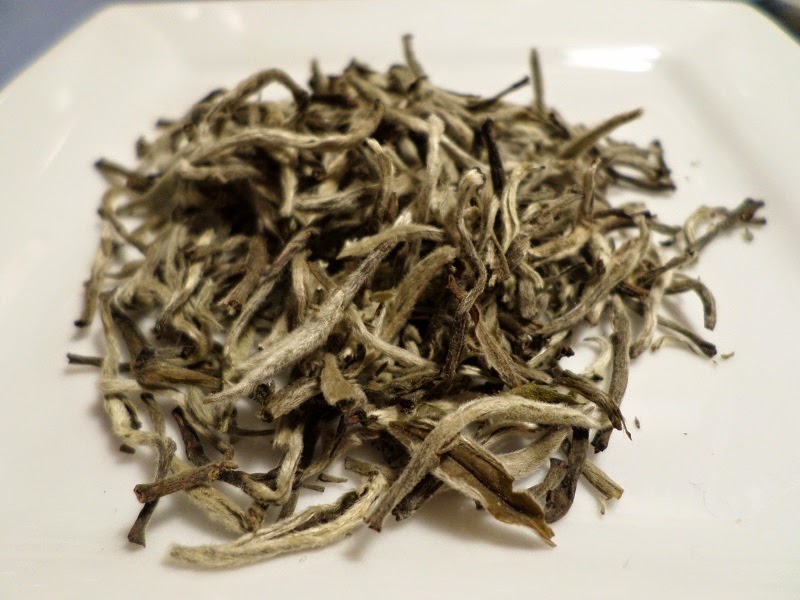
Opening the bag, I smell sweet hay in the field, and clover. How fresh and inviting. The leaf is long and silvery. Looking closely, you can see the tiny hair of youth on the buds.

The instructions call for 1 tsp of leaf. I am using a lot more as I will be preparing a mug sized serving - about 10 oz. Today I debated which teapot to use and finally chose the clear glass teapot. This was a great choice. Once the filtered 175F water was added, the leaf separated top an bottom, with most leaf standing or hanging vertically. There was some movement in the pot but mostly this was a wonderful posing event. Very appreciated.

The steep was 4 minutes. When I removed the lid it had another field scent. This time I could detect dandelion greens. I haven't even tasted yet and already this is complex.

The liquor, in the mug, is a golden sunshine yellow with a floral aroma. It was nearly clear in the pot but quickly darkens upon cooling. My first thought after pouring was this is very clear. Upon a closer look, the tiny bud fur can be seen floating about. I would not want it any other way.

The taste is a mix of cucumber and nutty. There is zero bitterness detected and no real bite. There is a slight amount of cheek tingle and dryness in the cup. As I continue to process the taste, I am picking up once again on the fresh sweet hay caught early in the dry leaf. As I finished the cup I caught a floral finish that once again reminded me of clover.

Golden Tips calls the taste perfectly fruity. I personally do not interpret the taste that way. What I am calling nutty might possibly be described as stone fruit though it is not a sweet fruit taste. It really is a matter of semantics, brewing technique, and water. The point is this is an excellent white tea.

I love how complex the session has been. The flavors, though more subtle than most black teas, do not hide if you pay attention. Remember to take your time with this one to seek out the nuances. You will be rewarded.

You can find Okayti Silver Needle Darjeeling White Tea Second Flush here.

Friday, January 2, 2015

What-Cha, Darjeeling 2nd Flush 2014 Rohini Clonal Special Tippy Black Tea

What-Cha Description:
A wonderful smooth single estate tea from Darjeeling with a sweet taste and spicy finish.

Price: $7.20/50g (1.76 oz)

Sample provided by What-Cha Tea Redefined

My Review:
This my second post and first review of 2015. What better way to start the year than with something from What-Cha. A new comer on the scene last year. They have already proven themselves to offer a wide range of affordable and top notch teas.

Today's tea is, I believe, the lowest priced of their black Darjeeling teas. At the price, this might make a good everyday tea, if it passes the audition. Let's check it out.

The 10g sample, is as always, packaged in a resealable aluminum pouch, having a simple and well laid out label with steeping recommendations.

Opening the bag, and breathing in the scent, gives me the immediate impression of Cheerios. It is an oat grain scent with a touch of malt.

I scooped out about 1/3 of the sample for pictures and steeping. This is mainly dark, almost black, twisted leaf with several instances of silvery tips.

I grabbed, and preheated, my $4 Goodwill teapot, added the leaf, and heated water to 203 F. With my Hamilton Beach electric kettle, I set the thermostat to 200 F. When it reaches the temperature it clicks to maintain the temperature. Except if you don't shut it off, it will continue to climb for a few degrees. I waited for 203 and removed the kettle from the base and poured into the teapot. I steeped for 2 1/2 minutes.


The wet leaf has expanded quite a bit to reveal large broken pieces that are green tinted and cinnamon. There also appears to be some stems in the mix.

The liquor is not the normal black tea dark orange color I expected. It has more of a brassy copper color. What was I thinking? This is a Darjeeling after all.

The aroma is fruity and lightly malt.

The taste is likewise a mix of fruit and malt. This is very easy to drink with no bitterness or astringency at the beginning. Late in the sip it picks up a bit of bite that What-Cha calls a spicy finish. I agree. It is not drying and leans toward a subtle sweet side as I have no desire to add sweetener to it.

The first cup went down very easily. I brewed cup two with the same leaf and a 3 minute steep. This cup is darker and more bronze looking. The aroma is very similar to the first cup.

The malt and fruit notes seem reduced in this cup and the definite spice note picks up in intensity. It is not a dramatic spicy but obvious.

This is a good solid everyday tea. I had a sandwich with the second half of the first cup and the tea stood up for itself very well. Personally, I think that is when everyday teas are at their best, when they are paired well with food.

You can find Darjeeling 2nd Flush 2014 Rohini Clonal Special Tippy Black Tea here.

Thursday, January 1, 2015

Happy 2015

Last year I reviewed a lot of really good teas here on The Everyday Tea Blog. I am excited to say there are already several samples lined up and ready to go for review in the coming year.

I thought for the first post of the new year I would share something a little different. I was contacted by Golden Tips Tea in India and asked if I would like to review some of their tea. I'm no fool. I said yes. This was late December just before Christmas. Nine (9!!) days later a box of samples arrived in my mailbox.

Here is a picture:


And a closer look:


The box was wrapped in cloth and the edges sewn. Then the corners were reinforced with what I assume is wax. I asked around of other tea drinkers and apparently this is not uncommon practice in this part of the world. It is, however, the first time I have seen it. I thought it was cool enough that I wanted to share the experience.

Under the material and inside the box were a number of samples:


I will start steeping on these and many others in the coming days. I hope you join me on my continuing quest to try, and review, every tea on the planet! This could take a while.

Happy New Year All and many great steeps!

Wednesday, December 31, 2014

The Persimmon Tree, Masala Chai


The Persimmon Tree Description:
Our Masala Chai tea combines premium organic Assam black tea leaves with warming cardamom, cinnamon, ginger, cloves, and other fragrant spices. This tea is finely balanced to create the perfect aromatic blend for you to enjoy black, or as it has been traditionally enjoyed, with milk and sugar.

Ingredients:
Organic Black Loose-Leaf Tea, Organic Cardamom, Organic Cinnamon, Organic Cloves, Organic Ginger

Sample provided by The Persimmon Tree Tea Company

My Review:
This month, for whatever crazy reason, I selected two teas from The Persimmon Tree that I normally would not drink. The first was French Vanilla Bean. It was really good. Today I am trying Masala Chai.

I have not had much love for chai in the past. Generally, I find it too over spiced for my tastes. I don't mind any of the ingredients in it, however the ginger is usually too heavy for me and a lot of companies add copious amounts of pepper.

I have come to expect The Persimmon Tree to venture off the path a little bit and deliver a balanced tea that is not overwhelming. Let's find out what happens...

I open the tin and the spices are pleasantly drifting into the air. I can make out more than just the ginger, so nice start.

The assam black tea appears to be little pellets. I also see ginger and cinnamon bark. I have no idea what cloves and cardamon look like. Probably, I am looking straight at them and don't know it.

I used my mug with a steel filter basket. The filtered water was heated to 195 F. The steep was, honestly who knows. My wife had me making her toast, as the toaster is in my den. I also heated a sandwich in the microwave. I am guessing 4-5 minutes.

Normally that would concern me, but traditionally chai is simmered on the stove for 8 minutes or so. As you can see mine came out plenty dark, yet it is not harmed.

The traditional method of brewing chai is to simmer it in milk or a combination of milk and water and use lots of sugar. I chose to use water only and make a western cup of black chai.

The taste as prepared is pleasant. The spices are all present but not overpowering. This may not please the purist but I am impressed. Or maybe once again this is what chai was supposed to taste like all along and what I have tried has not been so good?

The strangest part of this cup is that the assam tastes very fruity and almost green. I am thinking it is the interaction of the base with the ginger. I detect no bitterness and really little if any astringency.

Next, I added one packet of sweetener (Splenda), as chai is usually served very sweet. I think this brings out the spices, especially the ginger, without it becoming too heavy handed. The assam still has that interesting fruity green thing going on.

Finally, I added milk. I never add milk (except to my morning green tea powder), but this is chai, so I added milk. Shazam! This is really good. Past experience has been that milk mellows and mutes the flavor in the cup. That is why it is often added to strong bitter breakfast teas. Here it has done just the opposite. The flavors have spread out. I especially notice the cardamon now. Not that it is stronger than the other spices, rather it finally is asserting itself.

For the first time ever, I can say I actually enjoyed a mug of chai. So much so, I intend to try this again by simmering it over the stove in milk with sugar. Call me crazy. The chai monster in me may have just been awakened!

You can find Masala Chai here.

Tuesday, December 30, 2014

Bigelow, Ginger Snappish

Bigelow Description:
Savory, sweet and just a bit spicy, our Ginger Snappish herbal tea is the perfect combination of ginger and lemon. Create a new tradition this holiday season, snuggling up with a cup and relaxing by the fire while gazing at fresh fallen snow.

Ingredients:
lemongrass, lemon peel, cinnamon, ginger, lemon verbena, rose hips, natural gingersnap, and natural lemon flavor with other natural flavors (soy lecithin), licorice root, citric acid

My Review:
Another that I received as an early Christmas surprise from my friend GG. I did have this before Christmas but am just now getting around to posting. This one appears to be intended as a Christmas themed tea. I do not know if this is available only seasonally, as our local stores don't stock it, in or out of season. Bah Humbug to grocers who ignore the tea drinkers among us.

The tea bag comes wrapped in this bright cheery foil envelope. I only have the one bag, but the box they come in is even more festive. You can see it here.

The scent as I open the wrapper is ginger and lemon. I was expecting more of a ginger snap smell but then the label does say 'with lemon'. The lemon does not make me think lemon fruit, rather it is more lemongrass/lemon verbena.

The string is long enough that you won't have to fish it out of the cup later, and the bag contains almost 2.5g of herbs. Plenty for a real cup of herbal tea.

I steeped this for the recommended 4 minutes. The brew is cloudy yellow. The aroma is a pleasant ginger/lemongrass combination.

Interesting, the taste is far more lemony than I expected. Frankly it is the main flavor. The ginger appears briefly towards the end of each sip, just long enough to add a little heat and then fades rather quickly. This contains licorice root but I do not detect it in the sip.

I added sweetener to see how it affected the taste. Honestly, I preferred this without additions. It is pleasant and soothing, but I have to admit, it does not make me think gingersnap at all. It also does not coincide with any Christmas memories for me. The gingery aftertaste is not enough to bring out the Ho Ho Ho in me, on the other hand, as a quiet lemon cup it is very nice.

I mentioned in my review on Steepster that I would be more inclined to sip this one late at night in the summertime while sitting out under the stars.

You can buy this direct from Bigelow, or just maybe, it will be on your local grocers shelves.